ALICE THROUGH THE LOOKING GLASS | UK
ALICE THROUGH THE LOOKING GLASS
THE SEVEN-CORNERED PILLAR / UNITED KINGDOM
- TYPE
- Sculptural Architecture / Architectural Installation
- LOCATION
- England, United Kingdom
- COMMISSION TYPE
- Architectural Competition
- PROJECT FORMAT
- Competition Entry
- CENTRAL CONCEPT
- The Active Principle
- ARCHITECTURAL ELEMENT
- The Seven-Cornered Pillar
- GEOMETRIC LANGUAGE
- Circle / Cylinder / Sevenfold Transformation
- TEMPORAL STRUCTURE
- Seven Divisions / Seven Days of the Week
- SPATIAL PRINCIPLE
- Perspective / Choice / Transformation
- SYMBOLIC FRAMEWORK
- Wholeness / Action / Imperfection
- DESIGN METHOD
- Translation of Symbolic Principles into Physical Form
- THEORETICAL APPROACH
- Eidetic Story / Architectural Semantics
- STATUS
- Architectural Competition Proposal
To translate the timeless symbol of wholeness into an active architectural form, transforming the circle into a sevenfold spatial structure shaped by time, perspective and choice, and examining how abstract principles acquire meaning through their encounter with physical reality.
ALICE THROUGH THE LOOKING GLASS
The Seven-Cornered Pillar: An Eidetic Story
01. The Active Principle
This is a story about the Active Principle. The Principle as it exists and operates in the real world, rather than solely in the abstract world of language and ideas.
A principle, understood as a symbol, is two-dimensional and timeless. Within the realm of abstraction, it exists independently of the circumstances through which it might become manifest. Yet only when translated into the linear world, subjected to the conditions of time and space, can its formative power be examined.
This reconsideration of the semantics of symbols constitutes one of our fundamental architectural methodologies: the exploration of how an abstract principle acquires material existence without entirely losing its original meaning.
The Circle, as a symbol of wholeness, becomes the starting point of our investigation.
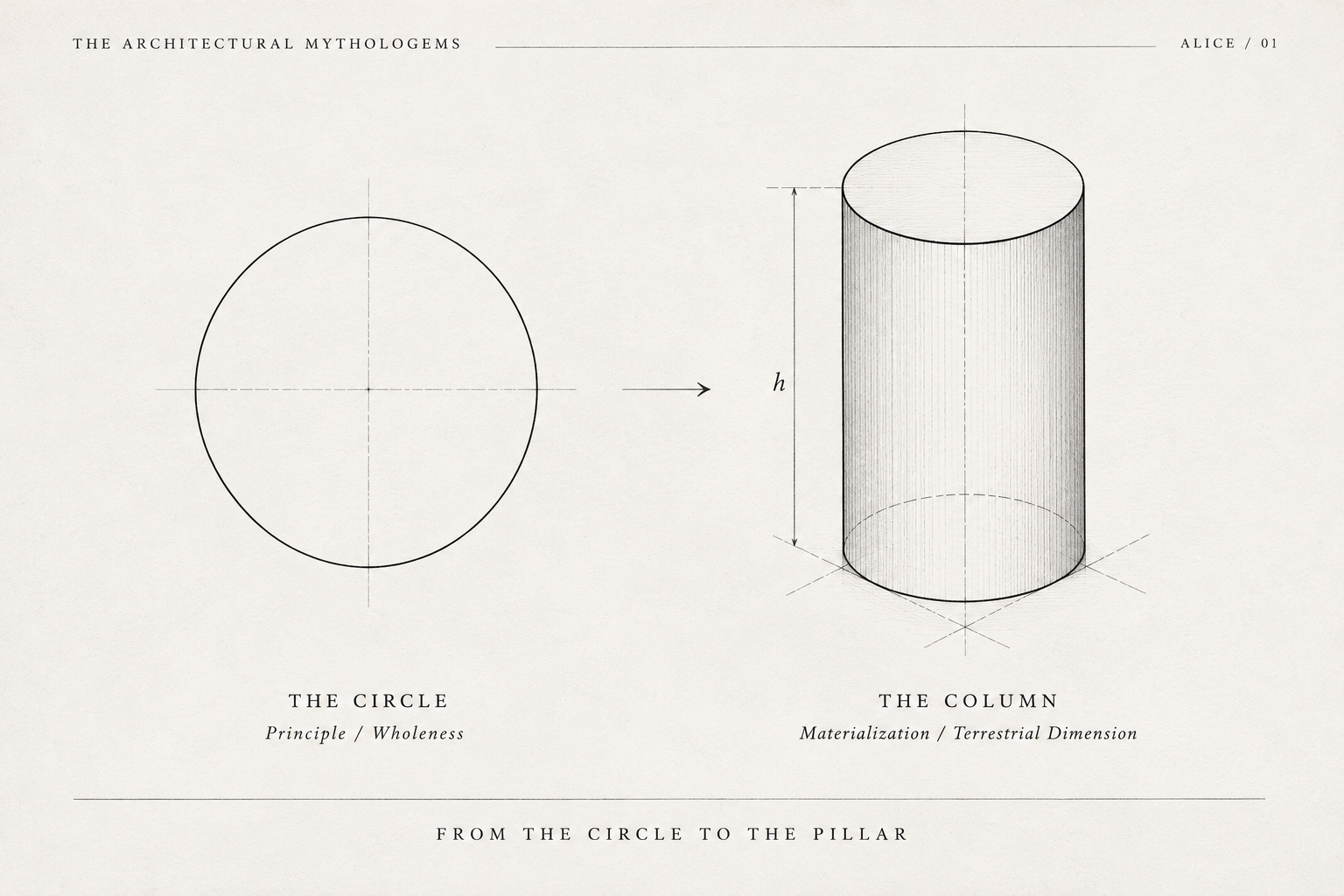
To ground the Circle, to introduce a terrestrial dimension, we give it height. Through this elementary operation, the Circle becomes a cylinder, a column.
The column is among the most enduring architectural and symbolic figures. From the Pillar of the World to the Ionic column, from the foundations of social institutions to the structural supports of a bridge, it expresses the idea of an element that carries, connects, and sustains.
With this symbolic and ontological pillar, we begin the story of the Seven-Cornered Pillar.
02. The Seven-Cornered Pillar: Time, Space and Choice
The first transformation of the Principle occurs through time.
The Circle is divided into seven parts, corresponding to the seven days of the week. What was initially continuous and indivisible becomes articulated into a sequence.
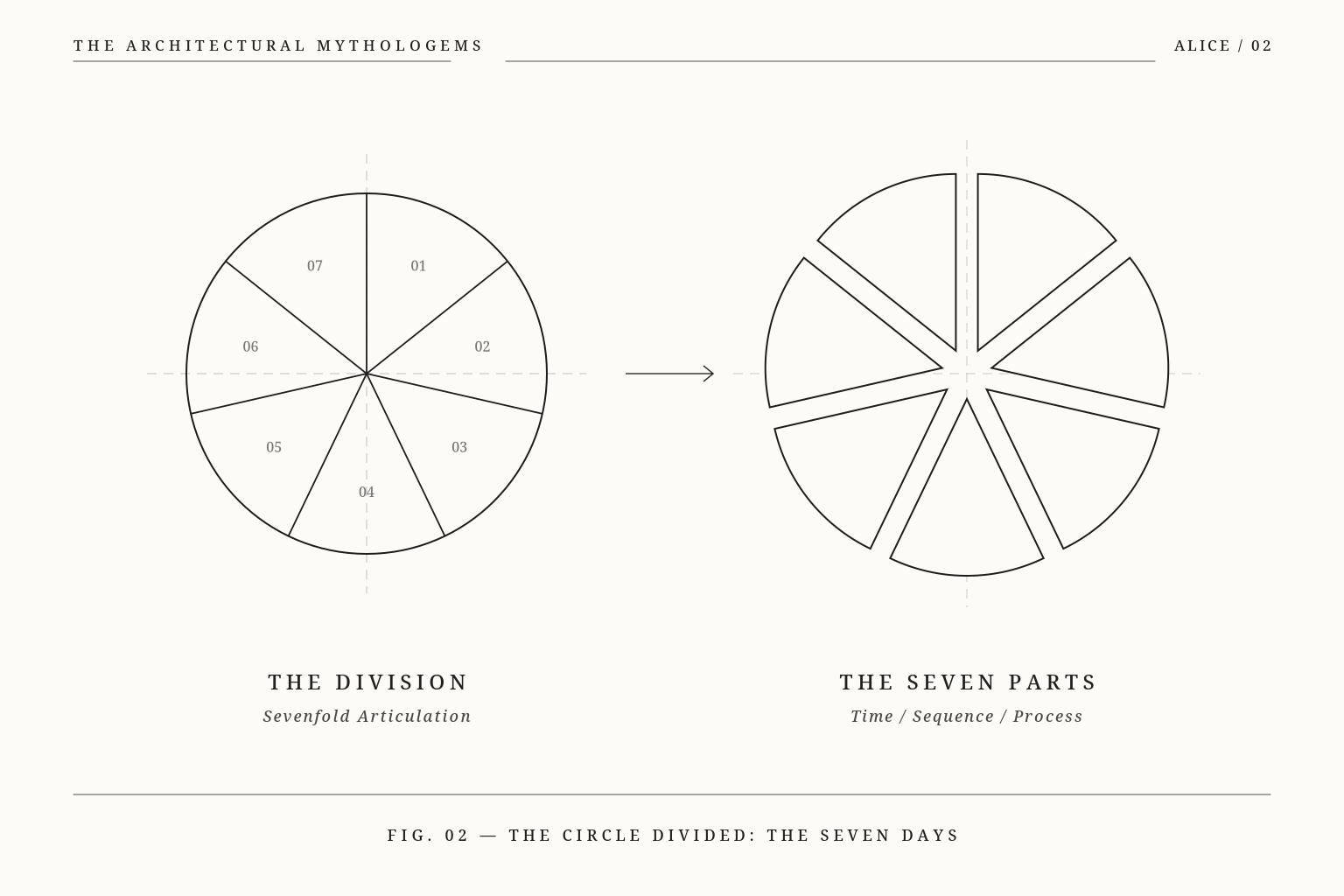
Yet this division is not merely numerical.
For the Principle to become active, it must cease to exist as a completed, monochromatic ideal. It must become open to experiences beyond itself. The original Circle is therefore distorted, interrupted, and exposed to the external world.
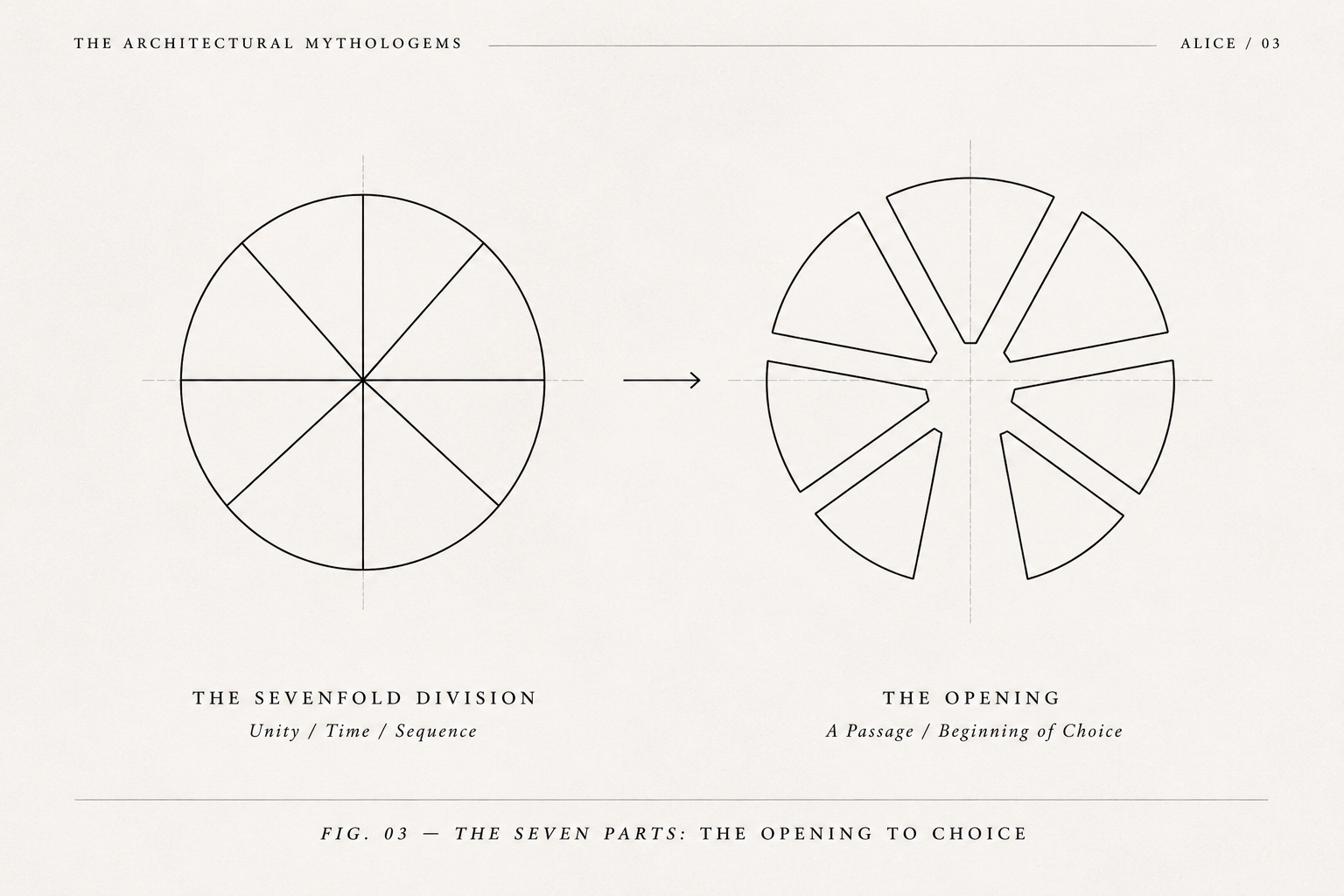
The Principle, now divided in time, undergoes a second transformation through space.
Each of the seven segments acquires height, developing into a vertical element. Together, these elements establish a system of pillars that preserves the memory of the original Circle while translating its geometric unity into an architectural structure.
At their upper ends, the pillars begin to branch. Their extensions become beams, establishing relationships between the vertical elements and forming the structural framework that supports the roof.
What began as a single geometrical figure now becomes an inhabitable spatial system.
Yet this transformation is not simply constructive. It also expresses the emergence of choices.
Spatial differentiation occurs at the points where the system encounters alternatives and is required to assume a particular direction.
The architectural analogue of these choices is the corner: an angle of perspective, a point at which one direction ends and another begins.
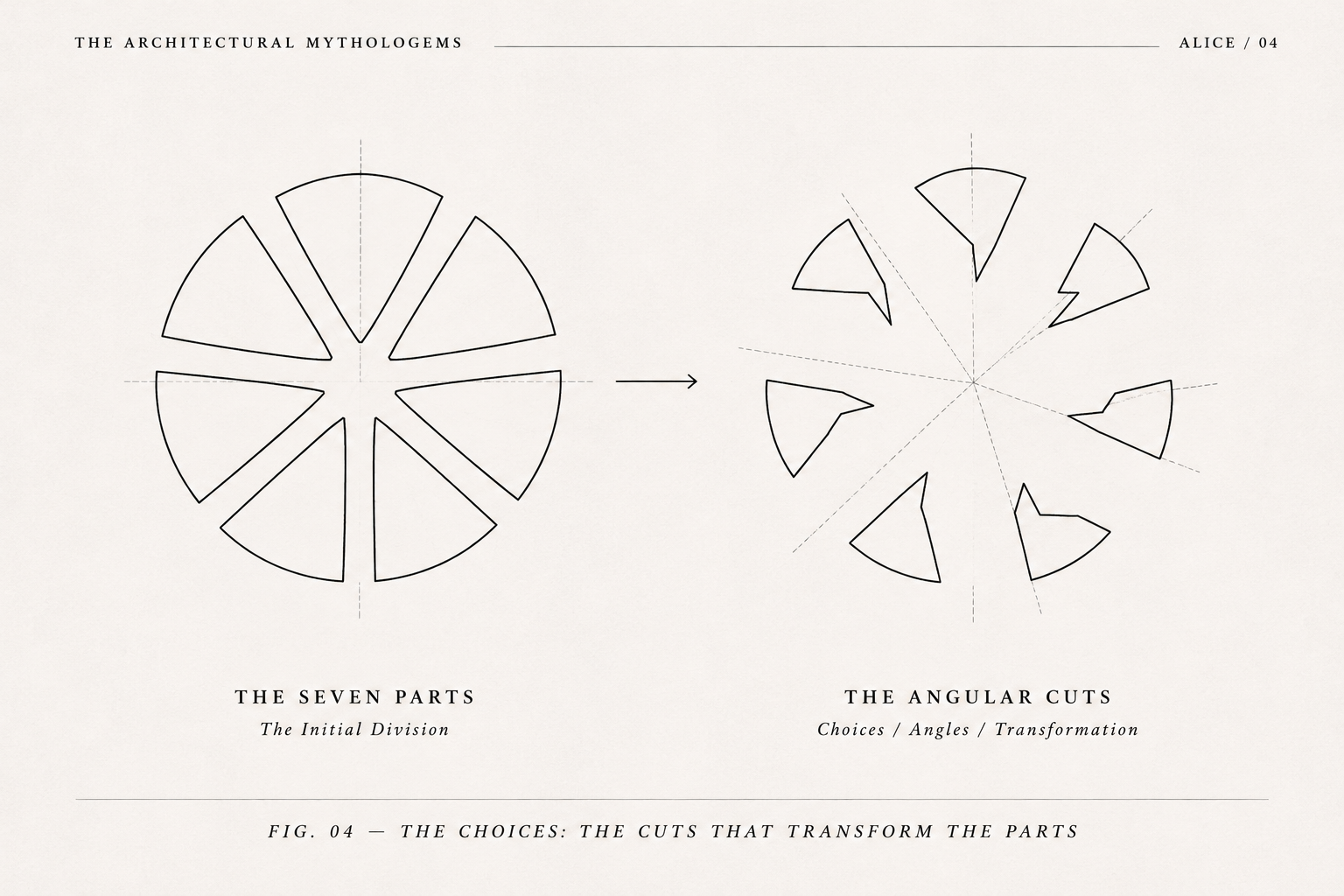
Every choice transforms the original condition. The aesthetic ideality of the Circle is compromised, but this apparent imperfection is precisely what makes its material existence possible.
The Principle can no longer remain an immaculate abstraction. It must develop through the consequences of its own activity.
At the points where choices occur, new spatial configurations emerge. Their projection and amplification generate the final architectural composition.
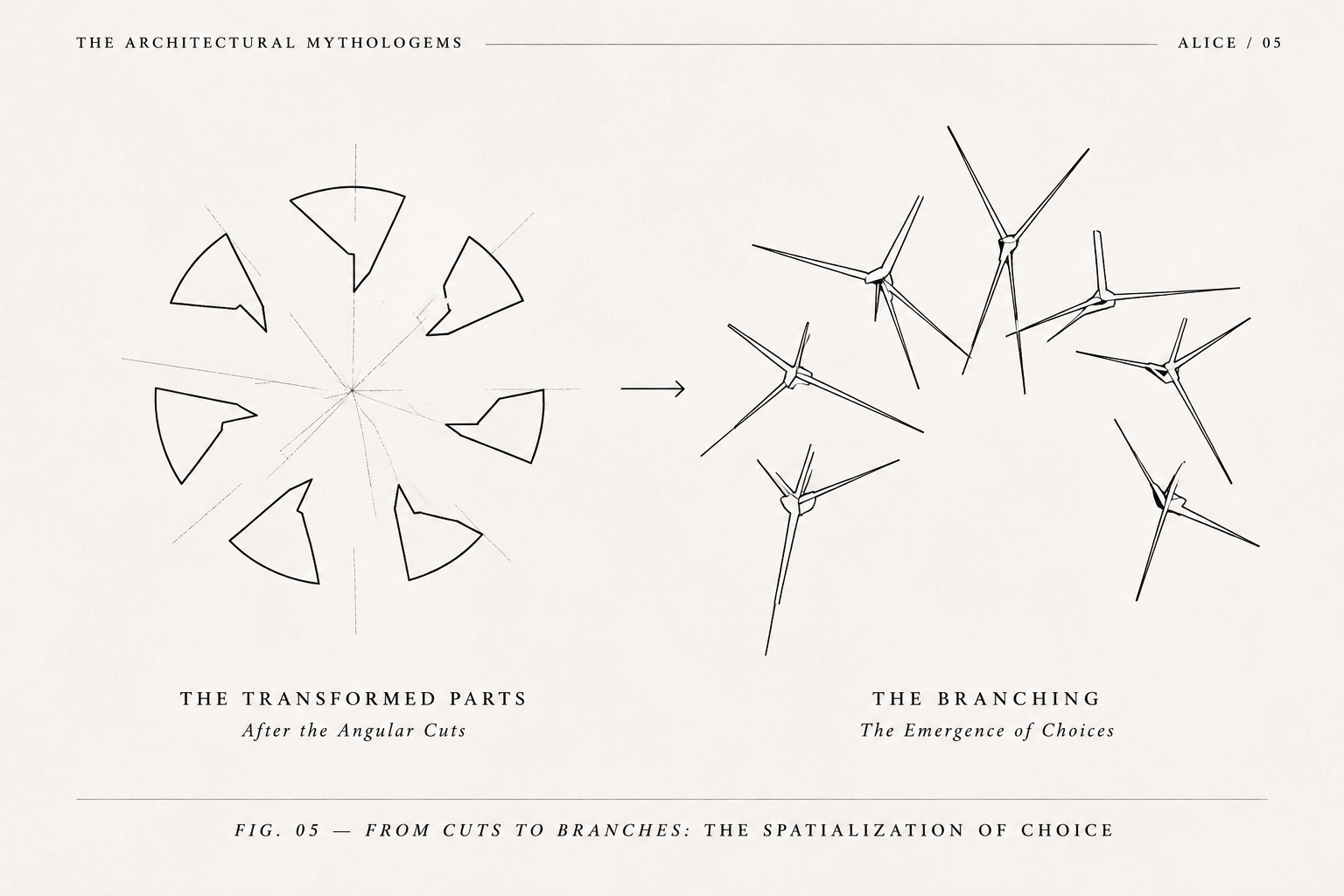
The resulting form is neither an arbitrary composition nor a mere geometric experiment. It is the visible record of a Principle transformed through time, space, choice, and consequence.
03. Prolegomena: This Is Not a House, This Is a System
The purpose of this project is to design a house that embodies the relationship between ideals and their realization.
The house is not understood as an isolated object, but as the material projection of a coherent system of relationships.
Despite its symbolic and ideological origins, the resulting architectural model remains grounded in pragmatism. Its conceptual structure does not negate functionality. Rather, the architectural organization attempts to demonstrate how the two can coexist.
This is not a house. This is the SYSTEM.
A system in which each element emerges from the preceding one and suggests the next. A system whose constituents are qualitatively and quantitatively contingent upon one another.
The reduction or elimination of an essential element would necessarily alter, and potentially collapse, the integrity of the whole.
The Circle requires its Pieces to become structured. The Pieces require Corners to establish relationships and directions. The Corners generate Tetragons, spatial consequences through which the system acquires an inhabitable form.
No element exists independently of the others.
The architectural whole is therefore not simply the sum of its constituent forms. It is the relationship that makes those forms mutually meaningful.
But how might these relationships be understood beyond the abstraction of a geometric diagram?
Perhaps the most appropriate explanation is to allow the elements themselves to speak.
The Seven Corners
of the Circle
One-act Drama
Before the architectural system becomes a building, its constituent elements are invited to participate in a conversation.
Four characters take the stage, each representing a fundamental condition of the creative process.
The Circle represents PRINCIPLE. It embodies the original ideal and the conceptual source of the entire system.
The Pieces represent STRUCTURE. They are the elements through which the Principle becomes organized and capable of supporting material existence.
The Corners represent CHOICES. They embody the moments of differentiation through which the system acquires direction, freedom, and spatial identity.
The Tetragons represent CONSEQUENCES. They are the resulting forms through which abstract relationships become tangible and inhabitable.
Each character considers its own role indispensable. Each is convinced, at least initially, that its particular contribution is the foundation upon which everything else depends.
Their disagreement reveals a fundamental question: can any element claim independence when its existence and meaning depend upon its relationship with the others?
The following dialogue explores this question through a small architectural drama.
The Conversation
The characters gather to discuss their role in the architectural system.
Dear shapes, yesterday we determined our task, so, if there are no objections, let us begin.
Mister Circle, we have a problem!
What is the problem?
Hm, last time you talked a lot, so we weren’t able to hear all of it…
We all know who always makes a problem.
So… Um… What is the subject of the conversation?
Why am I not surprised?
Circle, it’s fine! Long story short… We should explain to the rest of the world what we are and what we do!
That’s easy! We can begin!
No. We start from the top.
So I’ll begin! I am a principle, it is from me that all has ensued.
It is because of him that we all exist!
You are an ideal.
A perfect unity!
It is our turn now!
It is the pieces, our base, which keep us together. You are our stability, without you our entire structure could not exist.
We do like it. We would not add a thing. Moving on to the Corners.
Corners! They represent choices, freedom overall. It is upon those choices that even we are created.
And of course, our young Tetragons. They are sensuality, utility, pleasure and the present time.
We have remembered! You haven’t emphasized that it is because of us that all of you can now communicate! Without us you couldn’t be visible.
Let it be clear, visible or not, I exist in the fundament.
Undoubtedly, you are the foundation, but that is where your weakness lies. Unlike you, we perceive all and it is in our choice that the present time makes its appearance.
It is true that you offer a variety of choices, but we are chosen, we are living.
Despite all your possibilities, are you aware that it is our inside that you carry?
It is evident that each of us has pointed out to another one of our good points, but no one has remembered to mention how much we help one another. What a shame…
I speak of Pieces and Corners as I say: they help me perceive and understand myself! Pieces and Corners, Circle, if you had not understood yourself, we wouldn’t have a purpose in the present.
Also, without your actions, I would remain a secret.
And we are the result of your combined efforts. We are definite, we function, we speak. It is through us that we explain you, it is through us that you are living.
Shapes, this was a successful discussion. Tomorrow our conversation will be joined by more participants.
05. The Theory of Corners: Homage to Architecture
The corner. One of the most important elements of architectural anatomy.
Without corners, architecture as we recognize it would be fundamentally different. The corner is an apparently elementary condition, yet one of vital significance.
Within a coordinate system, its arrangement defines and establishes structure. It gives form to relationships between directions, boundaries, and spatial conditions.
Something so elementary, yet so indispensable.
The corner also carries an ethical and philosophical dimension.
It establishes a relationship between distinct elements, each of which acquires a particular purpose, function, and aesthetic identity through its connection to the others.
Apart from its use in architecture, we owe corners greater gratitude than one might initially imagine.
Corners are everywhere around us, provided we learn to recognize them as abstractions that constitute points of transition.
A corner is a moment of change.
It marks the conclusion of one direction and the beginning of another. It is the point at which continuity is interrupted and a new relationship becomes possible.
In language, the corner may be understood as the end of the first sentence and the beginning of the second. It marks the conclusion of one thought and the constitution of another.
In this sense, the corner does not merely separate. It also connects.
It represents the final instance of a profound choice.
It expresses the union or merger of two or more ideas, directions, or conditions.
Through this union, something new emerges that cannot be entirely reduced to its individual constituents.
Within architecture, the corner becomes a material articulation of this process.
It is simultaneously a structural condition, a spatial transition, and a symbolic representation of choice.
Its importance is therefore not exhausted by its geometrical properties. It also lies in its capacity to establish meaningful relationships.
A wall acquires direction through its encounter with another wall. A space becomes articulated through the relationships between its boundaries. An architectural composition develops its identity through the organization of such encounters.
The corner is the visible manifestation of these relationships.
Ultimately, the corner may be understood as a rhythmic articulation of transition from one form into another.
Wherever there is a notational system, wherever continuity is differentiated into meaningful intervals, something analogous to a corner can be recognized.
Even music depends upon such articulations. Without intervals, transitions, and distinctions, rhythm and melody would lose the relationships through which they become perceptible.
Architecture, likewise, emerges through the articulation of relationships.
The corner is one of the fundamental instruments of that articulation.
Within the Seven-Cornered Pillar, this elementary architectural condition becomes the principal means through which the abstract Circle is transformed into a differentiated spatial organism.
The corner is no longer merely a consequence of geometry.
It becomes an architectural expression of freedom, choice, and transformation.
06. The Architectural Manifestation
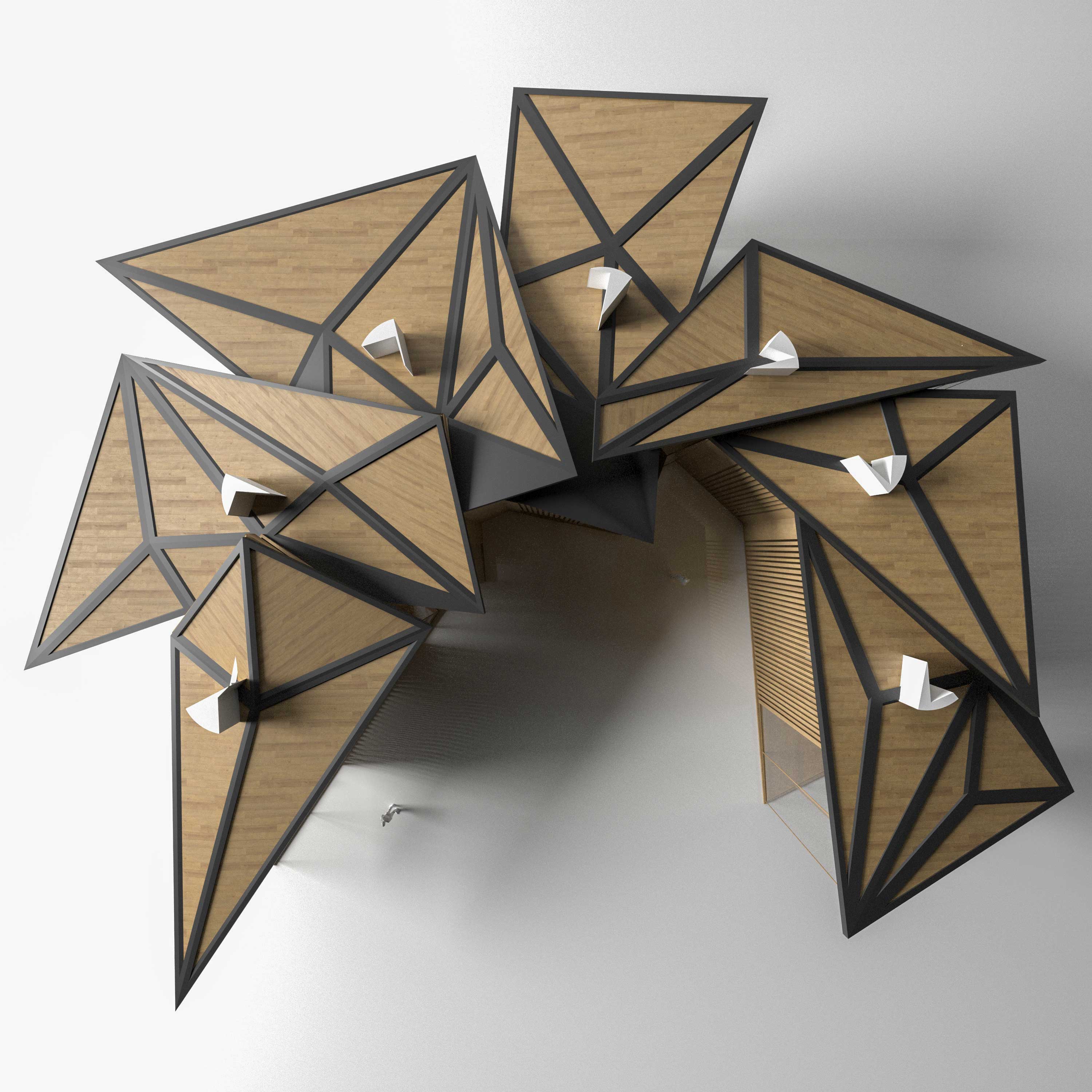
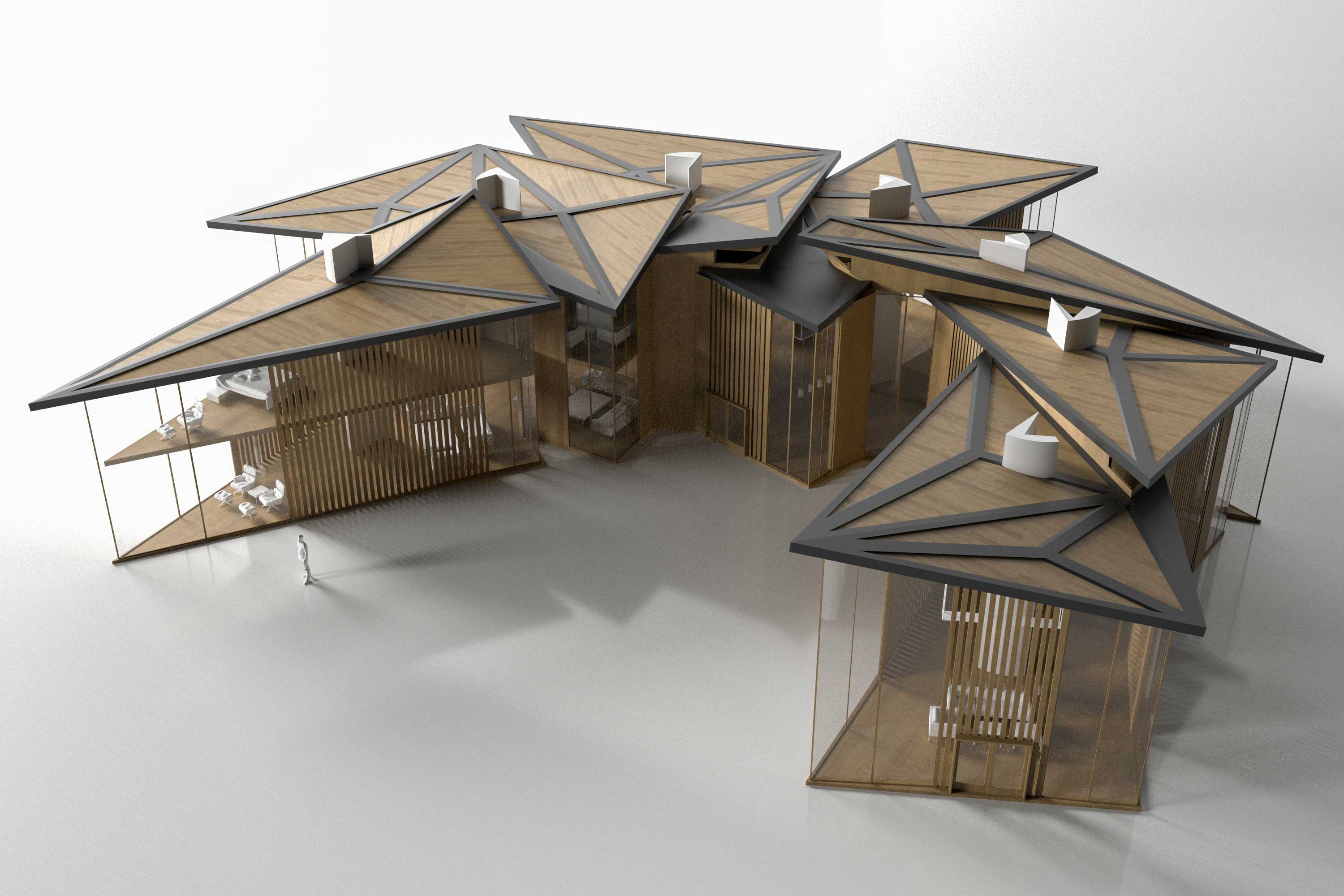
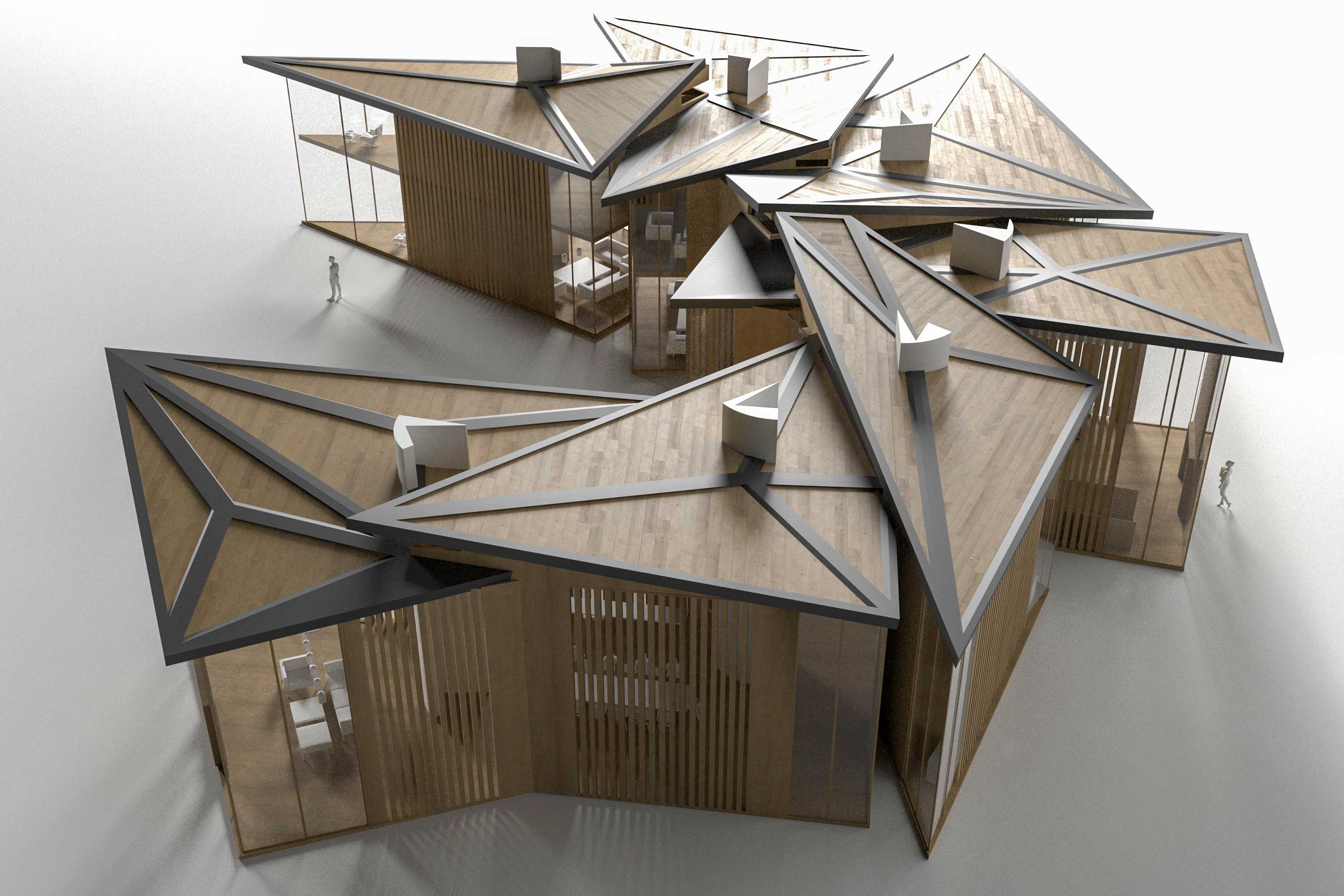
The final house is the material consequence of this sequence of transformations.
The original Circle establishes the conceptual unity of the project. Its division into seven parts introduces a temporal and structural articulation, while the vertical extension of these segments transforms the original figure into a system of pillars.
The branching of the pillars generates the beams that support the roof, establishing a constructive relationship between vertical and horizontal elements.
Through the emergence of Corners, the system acquires direction and spatial differentiation. Their projection and amplification produce the Tetragons that organize the architectural composition.
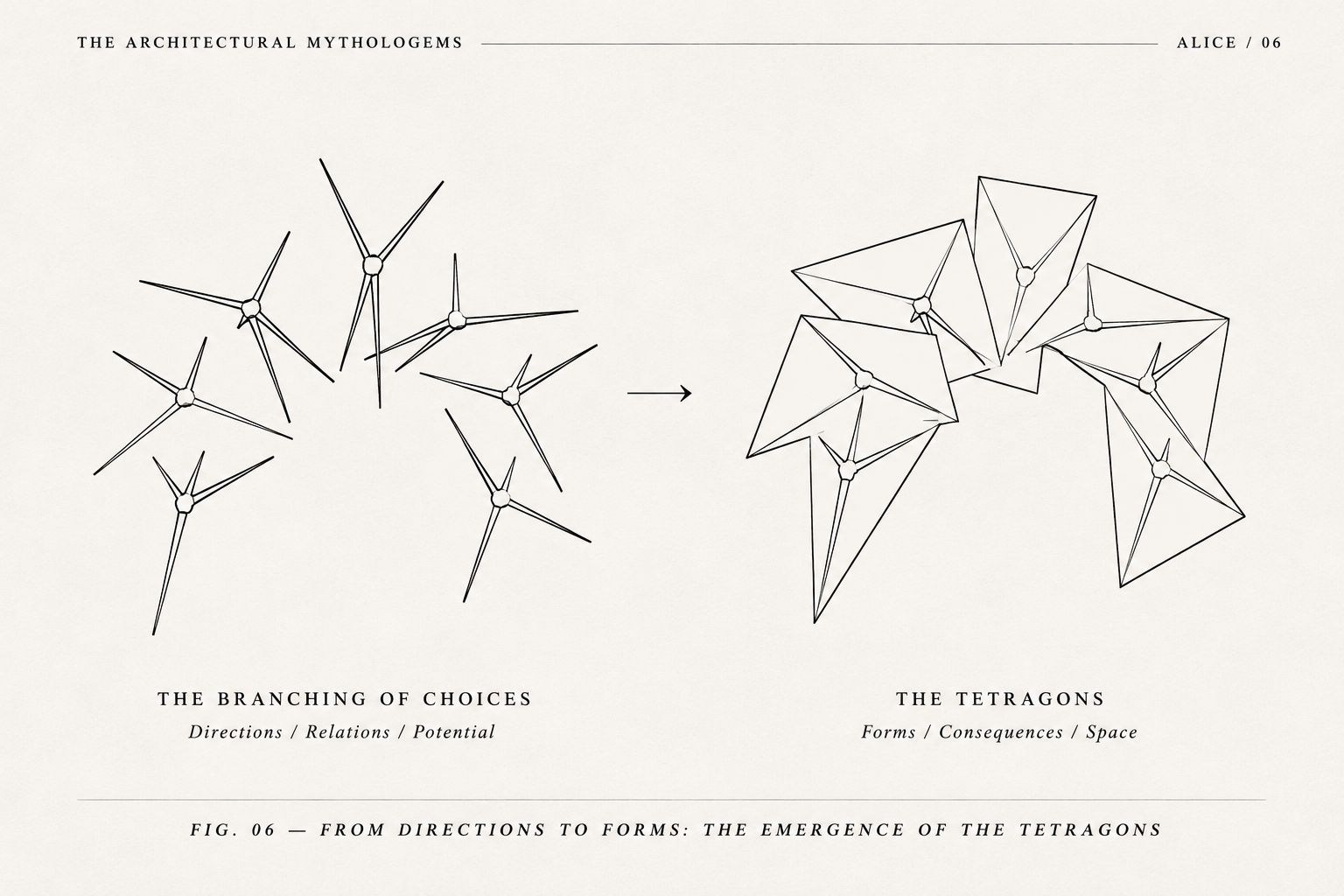
The resulting form develops around a shared conceptual center, while its individual elements establish different spatial relationships.
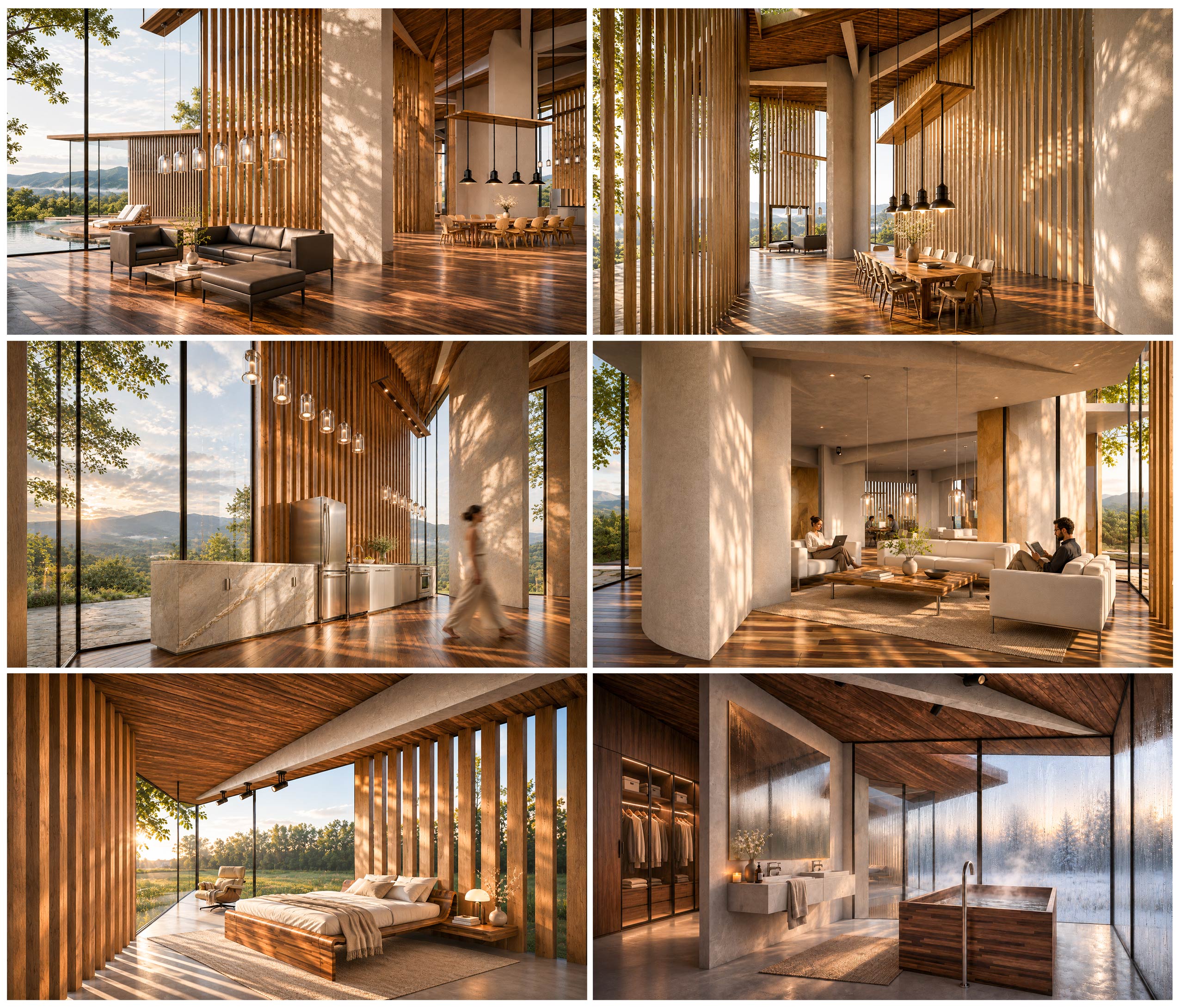
These relationships are expressed through the articulation of roofs, walls, openings, and transitional spaces.
The geometry is therefore not imposed upon the project as an external aesthetic preference. It develops from the internal logic of the system.
Each architectural element belongs to a sequence of causes and consequences.
The formal complexity of the building is the visible manifestation of an underlying conceptual order.
What initially appears fragmented is held together by a common origin.
What appears irregular is the result of a system of choices.
What appears to be a collection of separate architectural volumes is, in fact, the materialization of a single evolving Principle.
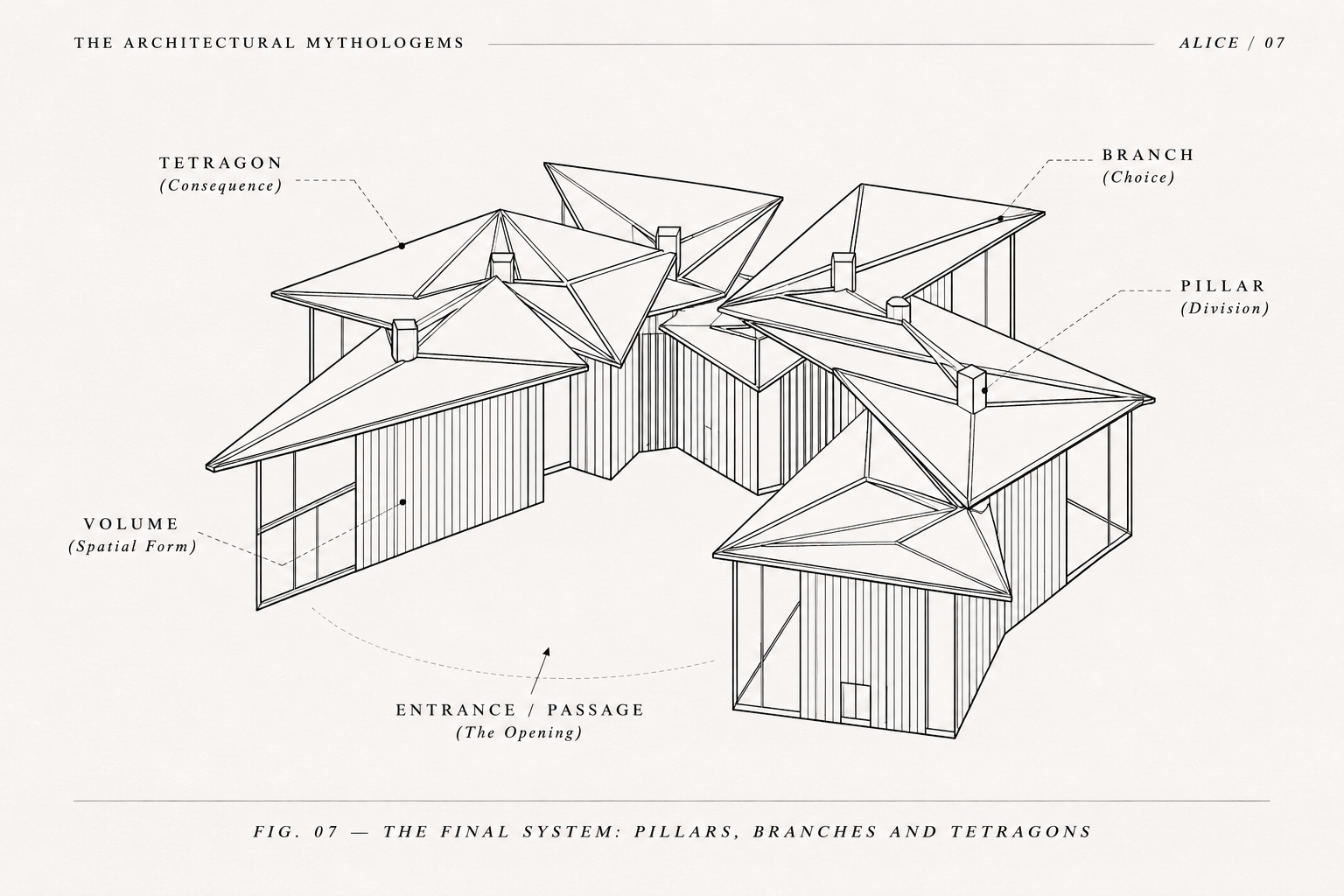
The Circle has not disappeared.
Its original geometry has been transformed, but its organizational presence remains embedded within the relationships that constitute the building.
The architectural form can therefore be understood as the actualization of a principle that has passed through a sequence of transformations without entirely abandoning its original identity.
07. Conclusion: From Ideality to Actuality
Alice Through the Looking Glass investigates the relationship between the ideal and the actual, the abstract and the material, the individual element and the system to which it belongs.
The project begins with the Circle, an image of unity and perfection, and follows its transformation through time, structure, choice, and consequence.
The resulting architecture does not attempt to preserve the original ideal in its untouched form.
Instead, it accepts transformation as the necessary condition of existence.
The Principle becomes meaningful not by remaining unchanged, but by entering into relationships through which its possibilities are realized.
Its original formal perfection gives way to a more complex condition: a unity constituted through differentiation.
The house becomes both an architectural object and a record of the process that produced it.
It is an exploration of how an idea becomes structure, how structure enables choice, and how choices become the spatial conditions of lived experience.
Architecture, in this sense, is not simply the representation of an idea. It is the process through which an idea becomes actual.