Tag / architectural theory
-
![]()
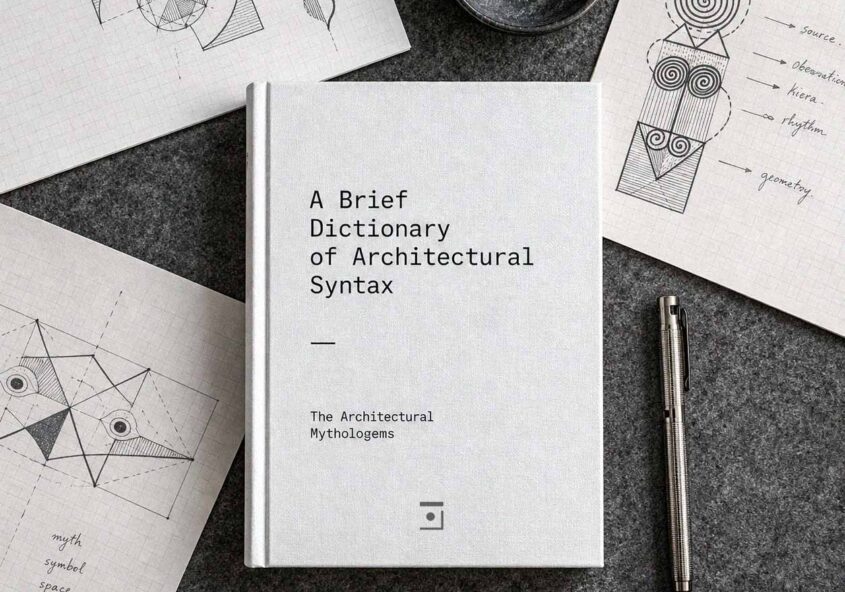
A Brief Dictionary of Architectural Syntax
Architecture must be understood as a language if we wish to make art of it, because every art form is, at its foundation, a language of its own. Not because buildings literally speak, but because architectural elements can carry meaning, establish relationships, construct sequences, and influence the way we experience space — as well as…
-
![]()
Manifesto Against Reduction
This is a manifesto for an architecture that refuses reduction. It refuses to reduce space to function, beauty to appearance, myth to fiction, or the human being to what can be measured. The Architectural Mythologems begins from another premise: architecture can question, reveal, disturb, and transform. What follows is not a statement of style. It…
-
![]()
THE EIDETIC DICTIONARY
Srpska verzija / Serbian Version A NORMATIVE GRAMMAR OF ARCHITECTURAL EPISTEMOLOGY A contextual framework for understanding architecture as psychic reality Audio Essay: THE EIDETIC DICTIONARY WHO IS THIS FOR? This treatise is intended for architects, theorists, and students who have transcended the understanding of architecture as a utilitarian discipline of shelter-building. It is intended for…
-
![]()
The Philosophy of Form in Architecture
The Philosophy of Form in Architecture: Navigating the Boundaries of Space Form in architecture is not just an aesthetic element; it is the essential language of space, the way buildings communicate with those who inhabit them. Just as minimalist design reduces every detail to its essence, so too does architectural form reveal deeper layers of…
-
![]()
Architecture and Philosophy
Understanding the deeper philosophical implications of the spaces we inhabit Architecture and Philosophy: Building a Bridge Between Thought and Matter Architecture is not merely a matter of aesthetics or functionality—it is, above all, a philosophical act. At its core, architecture represents the physical manifestation of ideas, cultural values, and philosophical paradigms that shape societies throughout…
-
![]()
Phantasmagoric Syntax
Theoretical elaborate for the J BRIDGE project. Audio Essay: J Bridge This is a philosophical-ontological game. This heuristic game will bring our attention back to the basic stories. The stories we articulate with the bridges of language. Phantasmagoric syntax The bridge is a sculptural manifestation of an archetypal sentence, a sentence that can be imagined…
-
![]()
Architectural Syntax – The Corner
The corner is a seemingly insignificant aspect of architecture, but it is actually a crucial element that plays a vital role in defining the appearance and functionality of a building. Its (Corner) placement in three-dimensional space is what dictates the overall design and silhouette of the structure. But what makes the corner such a strange…
-
![]()
Architectural Anatomy
It is almost a fun fact that many architects cannot clearly define the discipline of architecture. Often, the definition relies, quite uncertainly, on intuitive recognition (“I can not define it, but I know it when I see it”). However, there are many definitions that are being sought at the boundary between intuitive and analytical because…
-
![]()
Style – Stylistics
Style is a crucial element of an architect’s work, a tool they use to sign and distinguish their creations. However, it should not be viewed as a choice that exists independently of the larger architectural discourse. Many young architects fall into the trap of thinking that they can choose their own unique style, often prioritizing…
-
![]()
Four Corners of the Gaminite Circle
This text represents the normative grammatic for understanding the architectural project “The Three Corners of the twofold Circle“ Prologue Four Corners of the Geminate Circle is a Jungian concept that will be the central theme of this text which will once again culminate in architectural exegesis. Besides Jung’s thesis, the aesthetic categorization by Benedetto Croce…