
A Brief Dictionary of Architectural Syntax
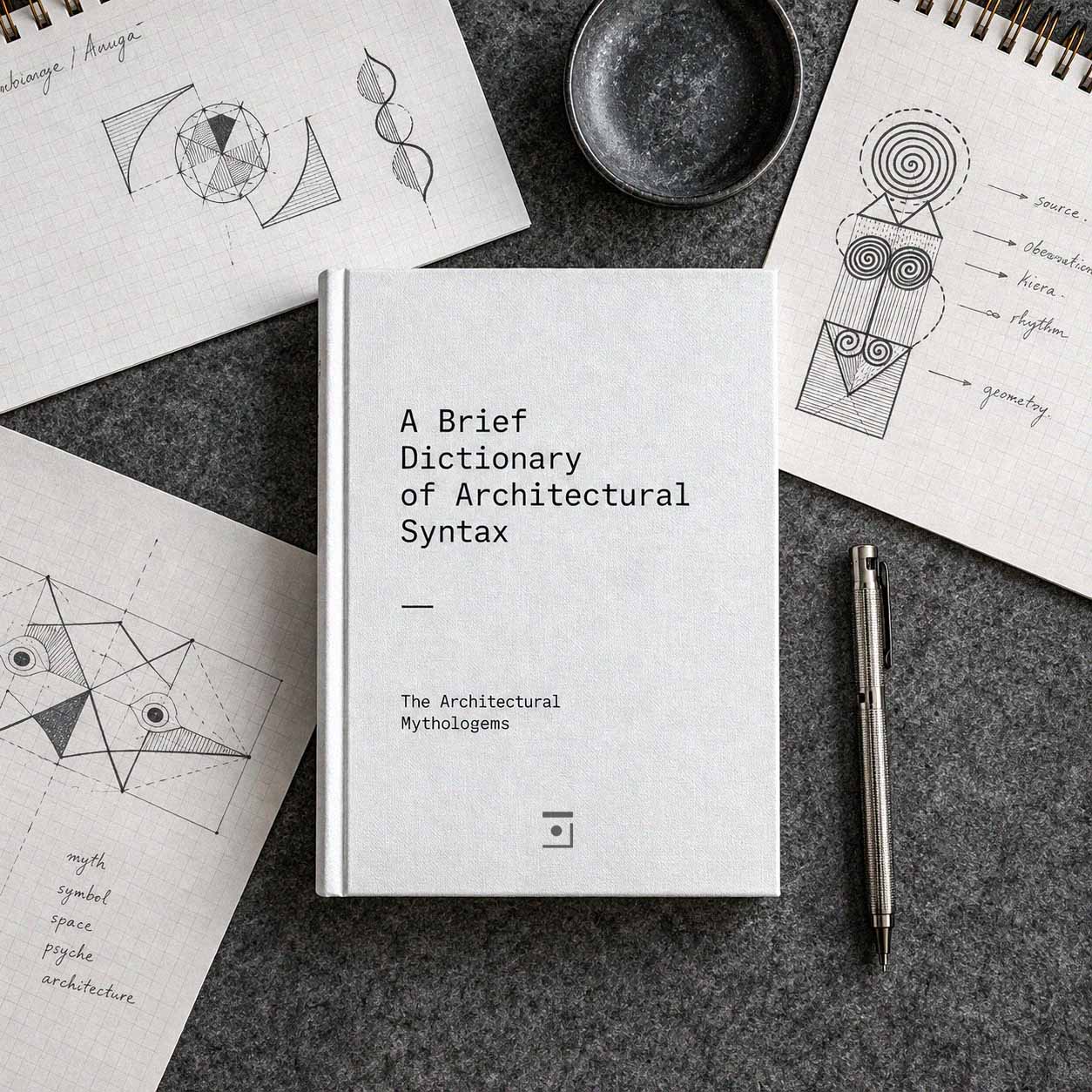
Architecture must be understood as a language if we wish to make art of it, because every art form is, at its foundation, a language of its own.
Not because buildings literally speak, but because architectural elements can carry meaning, establish relationships, construct sequences, and influence the way we experience space — as well as what that experience of space may alter, inscribe, or set in motion within us.
At this point, however, a brief digression is necessary. Unlike film — and despite what the culture of social media often suggests — architecture is not movement. Part of its greatness lies precisely in this fact. Movement exists in time, but it also disappears within time: it happened, and it is no longer happening. Architecture, in this sense, is like movement captured by a camera — movement arrested and decomposed into static sequences of its own constitution.
Its “static” character and its apparent “immutability” are precisely what allow it to become a consistent principle. A principle that belongs not merely to the spirit of the present moment, but to deep time. Architecture is enduring rather than instantaneous.
The contemporary age, however, is obsessed with immediate trends and attempts to compress architecture into the same framework of transience. Yet architecture fundamentally escapes such a framework. Whenever it is reduced to the logic of the instantaneous, it becomes impoverished: it ceases to function as language and is reduced to the banality of ornament.
Let us therefore return to the fundamental proposition. If architecture is understood as a language, then it must possess something analogous to vocabulary, grammar, and syntax.
The Architectural Sign
An architectural sign is an element that carries meaning beyond its immediate physical function.
A wall may separate two spaces, but at the same time it may signify a boundary, a category, or a set. In this sense, a wall may be understood as a sentence — as a thought — or as the surface upon which a sentence is written. The point at which one wall ends and another begins may represent a change of thought. The arrangement of walls within space, considered as a whole, constructs what we might call architectural discourse.
A threshold, on the other hand, may simply indicate an entrance, but it may also represent a transition from one state to another, or from one thought to another. Depending on the relationship it establishes with the surrounding walls, it can assume the role of punctuation: a comma, a full stop, a question mark, or an exclamation mark. It may close one spatial thought, while simultaneously announcing the one that is yet to come.
Here, an important distinction between verbal and architectural language becomes apparent. Architecture does not have to be linear. Its “reading” may unfold in several directions simultaneously, while the meaning of an individual sign also depends on the position of the observer, their movement, and their relationship to other signs within space.
The sign is therefore the initial condition of architectural meaning:
something is present, and its presence means something.
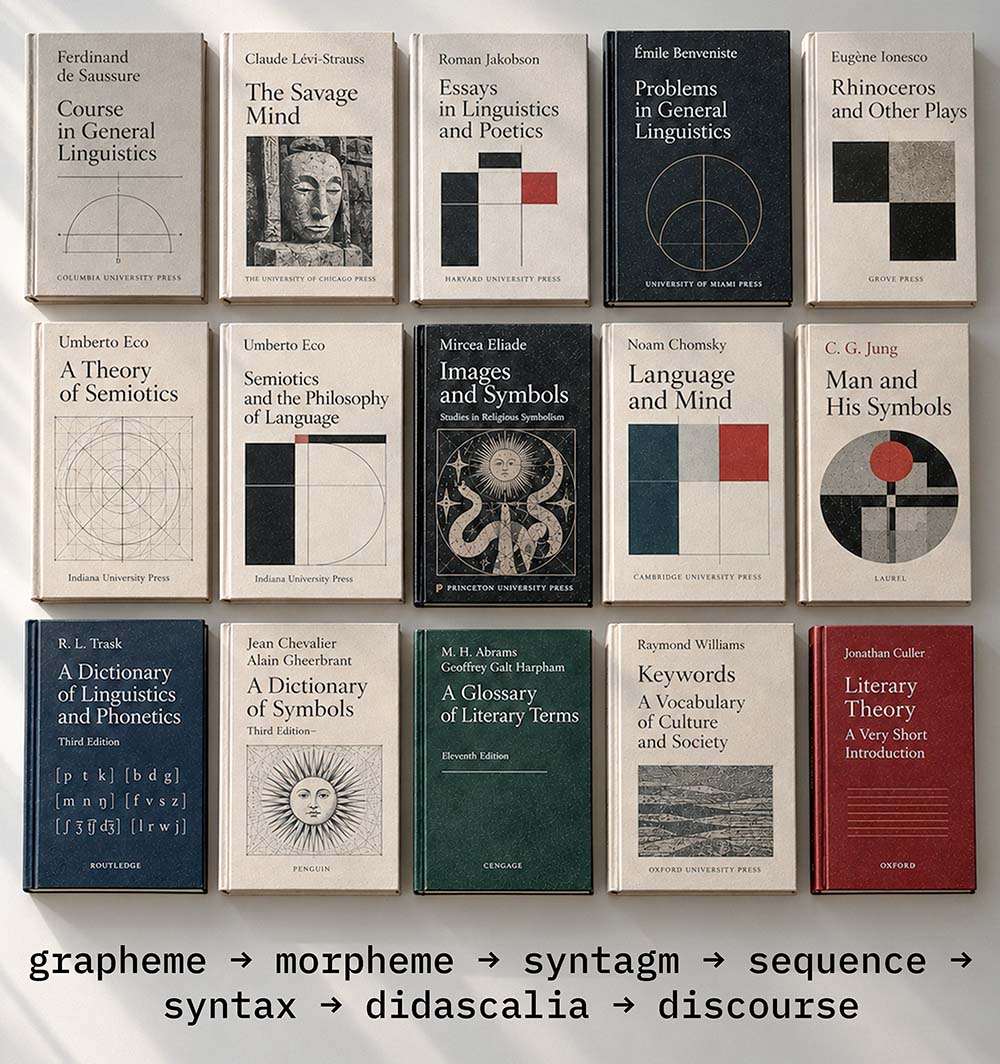
Architectural Syntax — A Brief Dictionary of Terms
If architecture is understood as a language, then its structure does not begin with the building as a whole, but with the smallest units from which that whole is constructed.
Just as language consists of signs, words, relationships, sequences, and sentences, architecture can likewise be understood as a system in which physical elements gradually enter into relationships, acquire meaning, and ultimately form architectural discourse.
This dictionary therefore progresses from the smallest unit to the largest:
grapheme → morpheme → syntagm → sequence → syntax → didascalia → discourse

Grapheme
A grapheme is the smallest non-semantic unit of architectural language.
It is the smallest physical element participating in the construction of architectural form, yet it does not necessarily possess a specific meaning on its own.
A beam, column, slab, plank, frame, opening, panel, wall segment, or another basic structural or spatial element may function as a grapheme.
Its essence lies not in meaning, but in its capacity for combination.
Just as a finite number of letters makes possible the creation of an almost unlimited number of words, a limited number of architectural graphemes can generate an unlimited number of spatial expressions.
The grapheme is, therefore, the material of architectural language before meaning — a pre-linguistic thought, pure form.
Morpheme
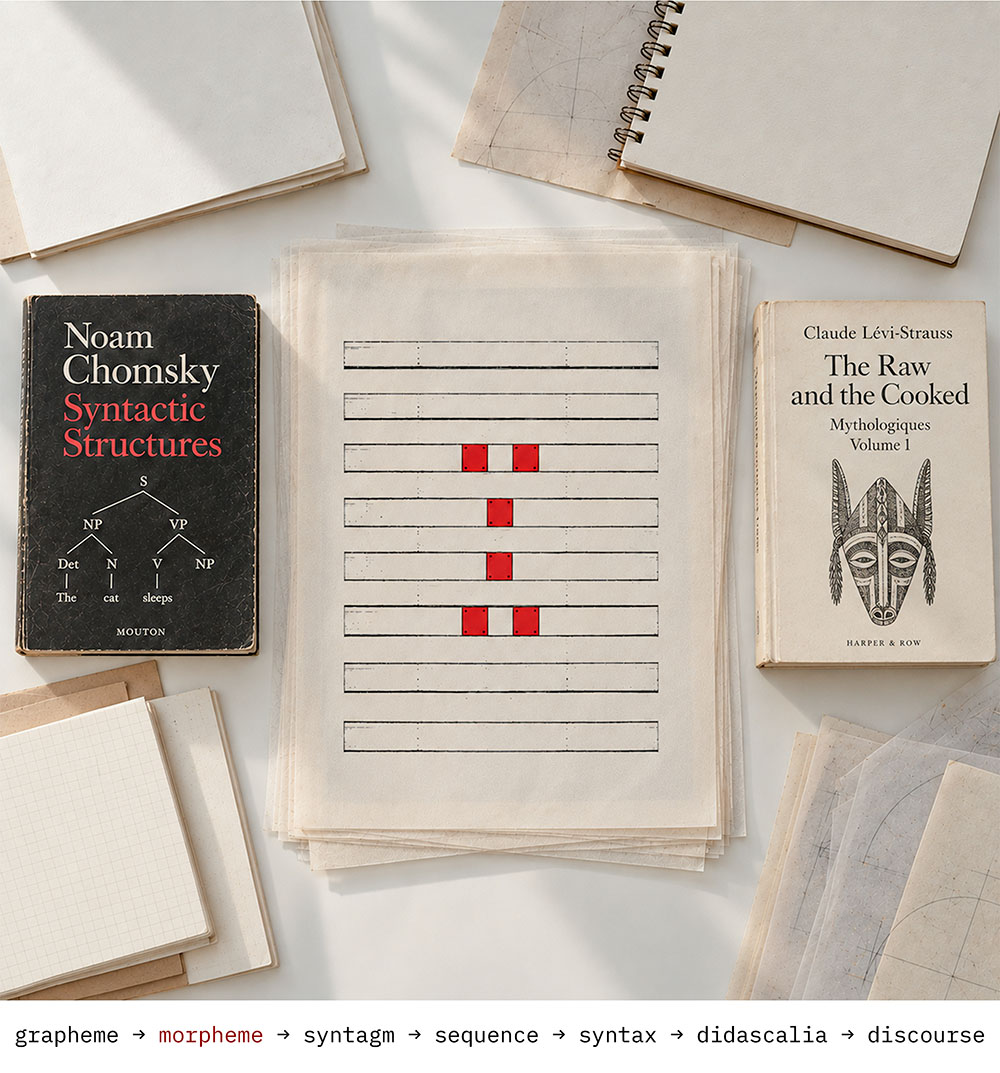
A morpheme is the smallest semantic unit of architectural language.
Unlike the grapheme, the morpheme possesses a specific meaning.
A physical element becomes a morpheme when it ceases to be merely a material fact and begins to signify something.
A wall is no longer merely a wall.
It may become a boundary, protection, interruption, belonging, separation, or enclosure.
An opening may become a view, a passage, or an announcement.
A column may cease to function merely as a structural support and become a sign of order, rhythm, or hierarchy.
The morpheme is therefore the moment in which the physical becomes meaningful.
Syntagm
Meaning, however, is almost never produced through a single element alone.
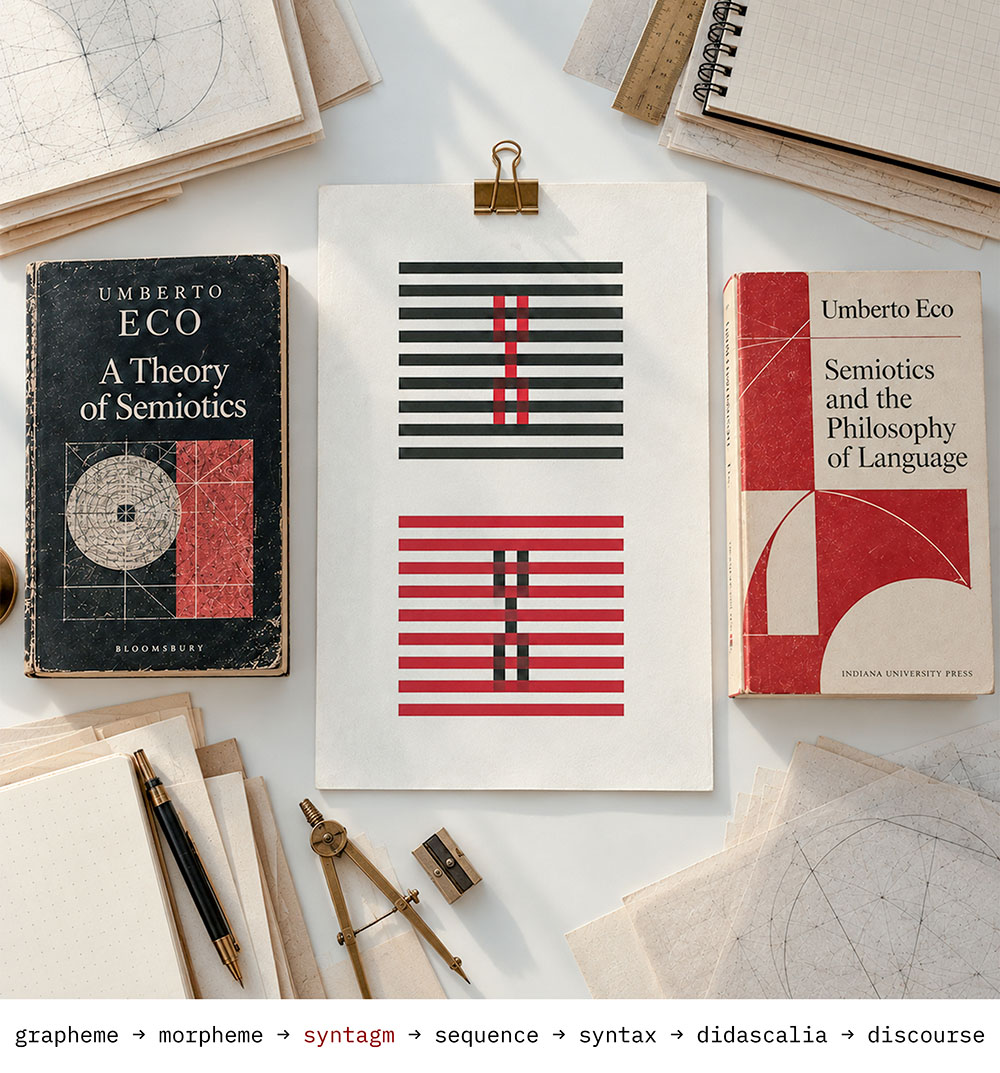
A syntagm emerges through the relationship between at least two elements.
A concept acquires its full meaning only when it is brought into relation with something else.
Fullness exists in relation to emptiness.
A wall in relation to an opening.
Interior in relation to exterior.
Light in relation to shadow.
A boundary in relation to the space it defines.
A syntagm is therefore not simply the presence of two elements, but the relationship between a concept and the context in which that concept exists.
The same wall does not mean the same thing when placed in the middle of an open space, at the edge of a plot, or between two intimate rooms.
Meaning is not contained solely within the element.
It emerges between elements.
Sequence
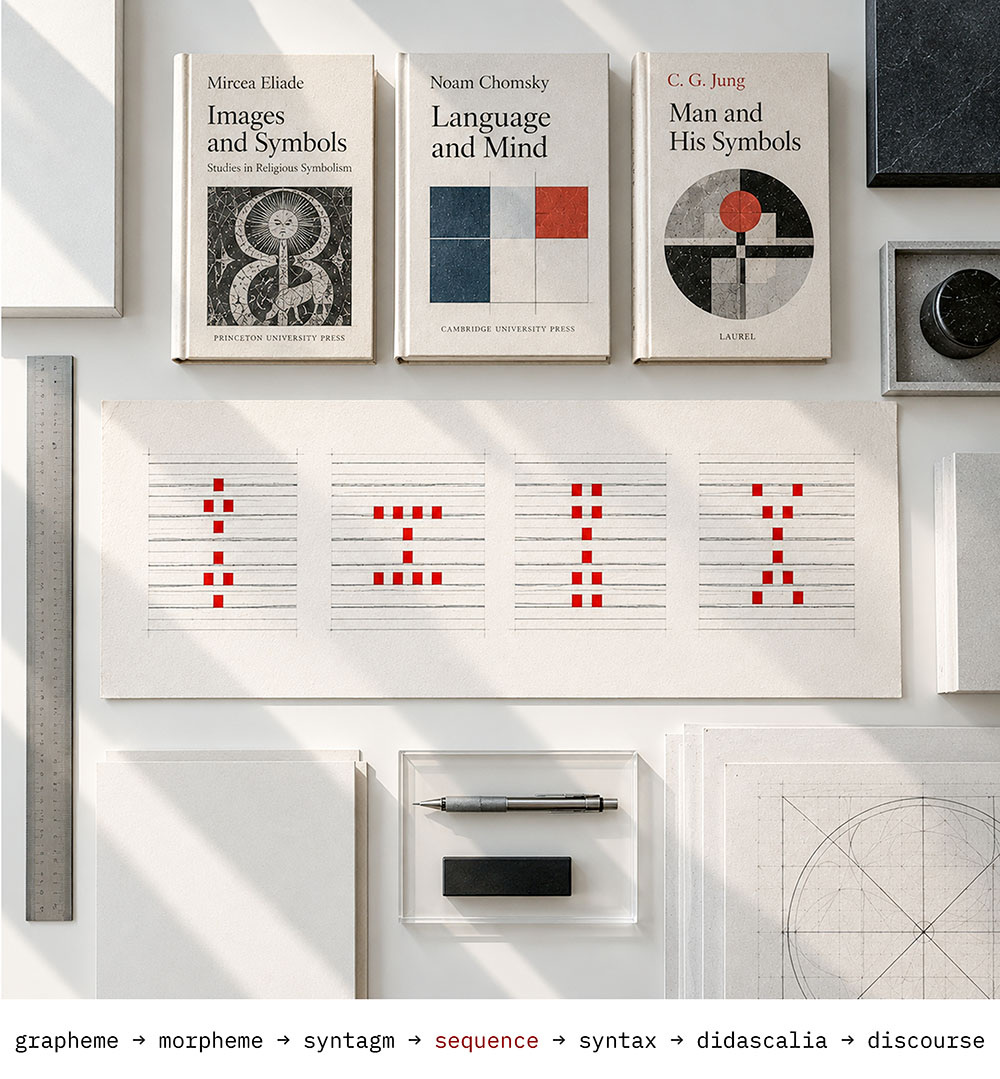
When several syntagms are organised into a particular order, a sequence emerges.
Sequence introduces order, progression, and hierarchy into architectural language.
It is not the same whether we first encounter a wall, then an opening, and finally a courtyard, or whether we first enter an open space and only afterwards encounter a boundary.
Changing the order changes the meaning.
Sequence therefore determines how architecture is read through space and time.
It establishes what comes before, what comes after, and what occupies a dominant or subordinate position.
Architecture is therefore no longer merely a collection of relationships.
It becomes a succession of relationships revealed in a particular order.
Syntax
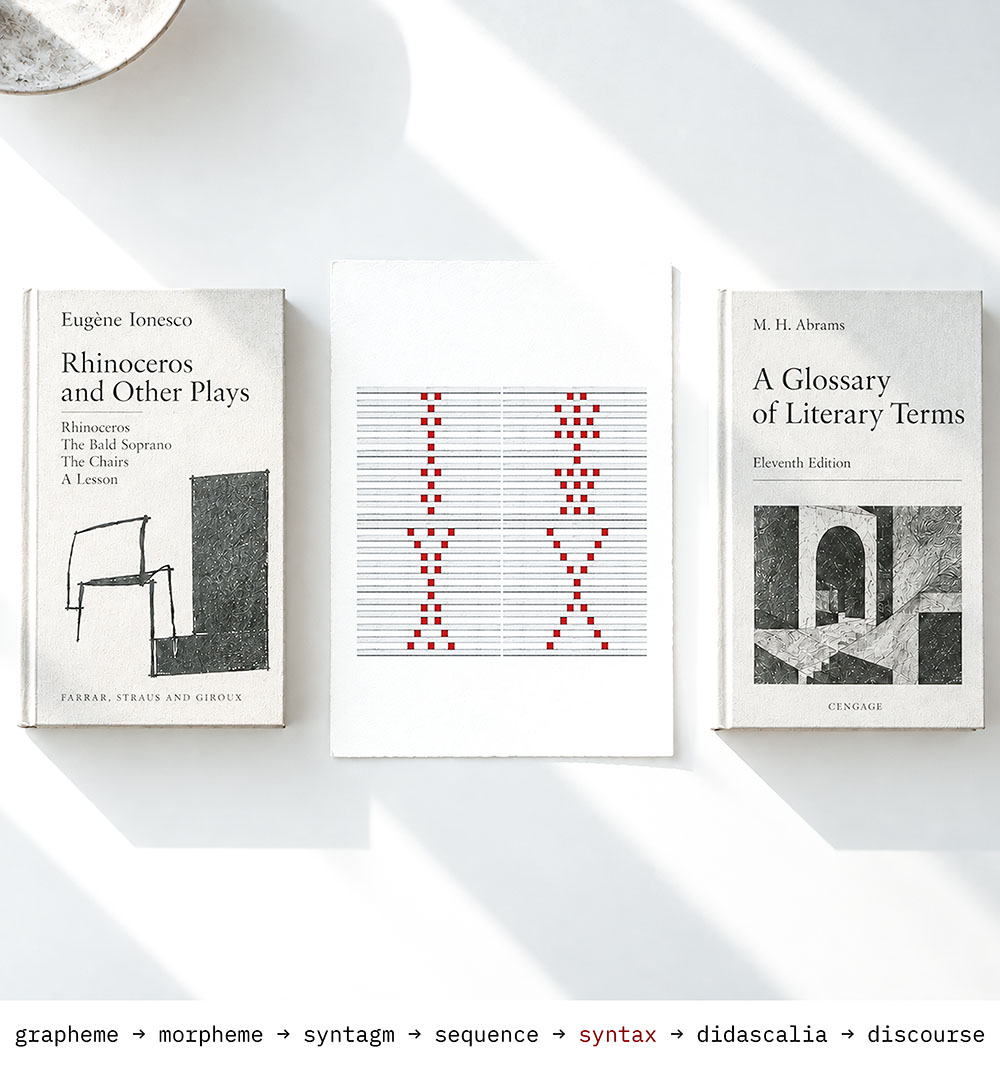
Syntax is the complete architectural sentence.
It emerges through the combination of graphemes, morphemes, syntagms, and sequences into a coherent spatial structure.
Syntax is neither an individual element nor merely the relationship between two elements.
It is the way in which all of the previously mentioned constituents operate together.
If the grapheme represents the basic physical material of language, the morpheme its smallest unit of meaning, the syntagm the relationship between those units, and the sequence their order, then syntax is the whole that transforms these relationships into architectural thought.
A building, a space, or a part of a city may therefore be understood as an architectural sentence.
Its value no longer depends solely on the appearance of its individual elements, but on how those elements are organised and what they say together.
Didascalia
But writing a sentence is not enough.
It is also necessary to understand how it is meant to be read — particularly when the sentence is not necessarily read linearly.
This is where architectural didascalia appears.
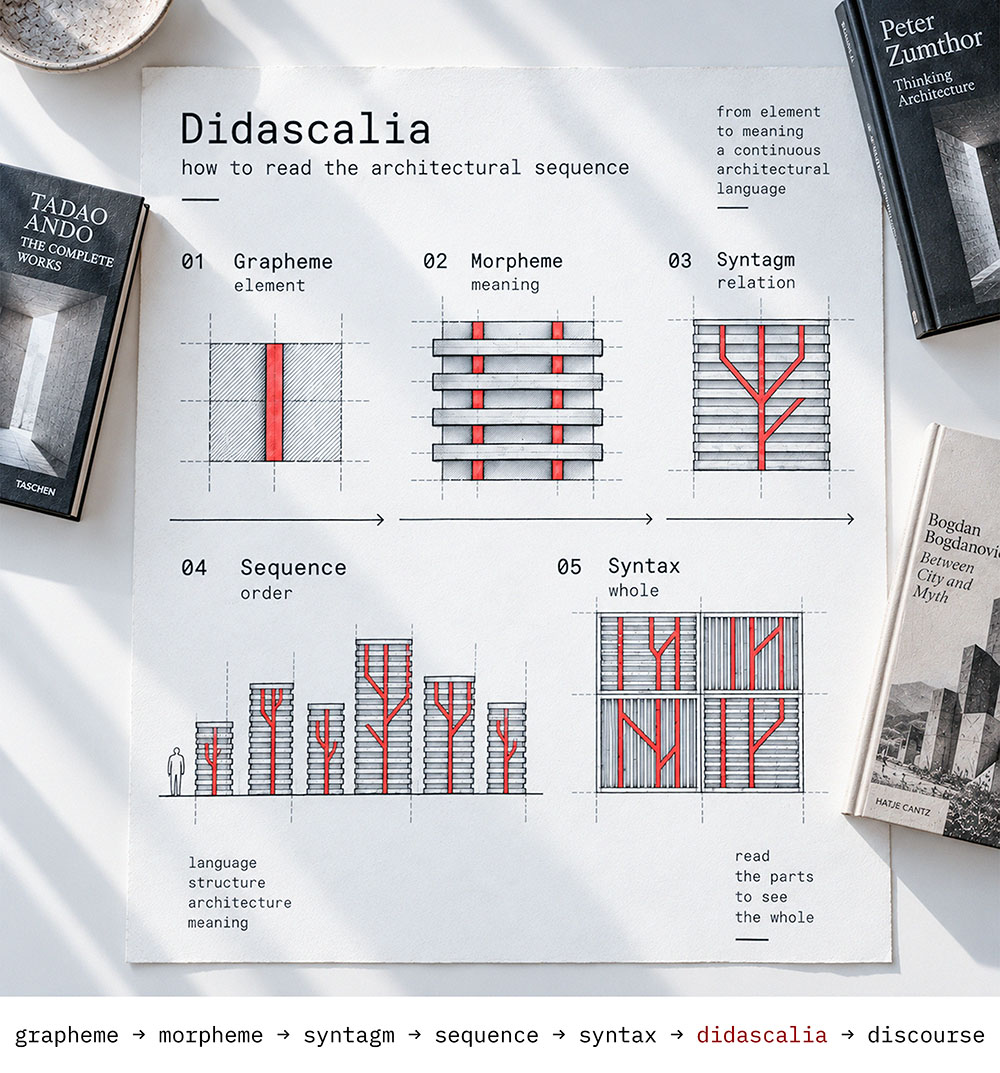
Didascalia is the instruction for reading architectural syntax.
It determines or suggests the way in which the user should approach a space, move through it, and perceive the relationships within it.
Stairs may slow movement while amplifying verticality.
A narrow passage may intensify a sense of pressure.
An opening may direct the gaze.
Light may emphasise a particular element.
A change in level may mark the transition from one spatial condition to another.
Didascalia does not have to be written.
It is embedded within the architecture itself.
If syntax is the architectural sentence, didascalia is the instruction for its performance and its reading.
Discourse
An individual architectural sentence is not an end in itself.
It belongs to a larger system of meaning.
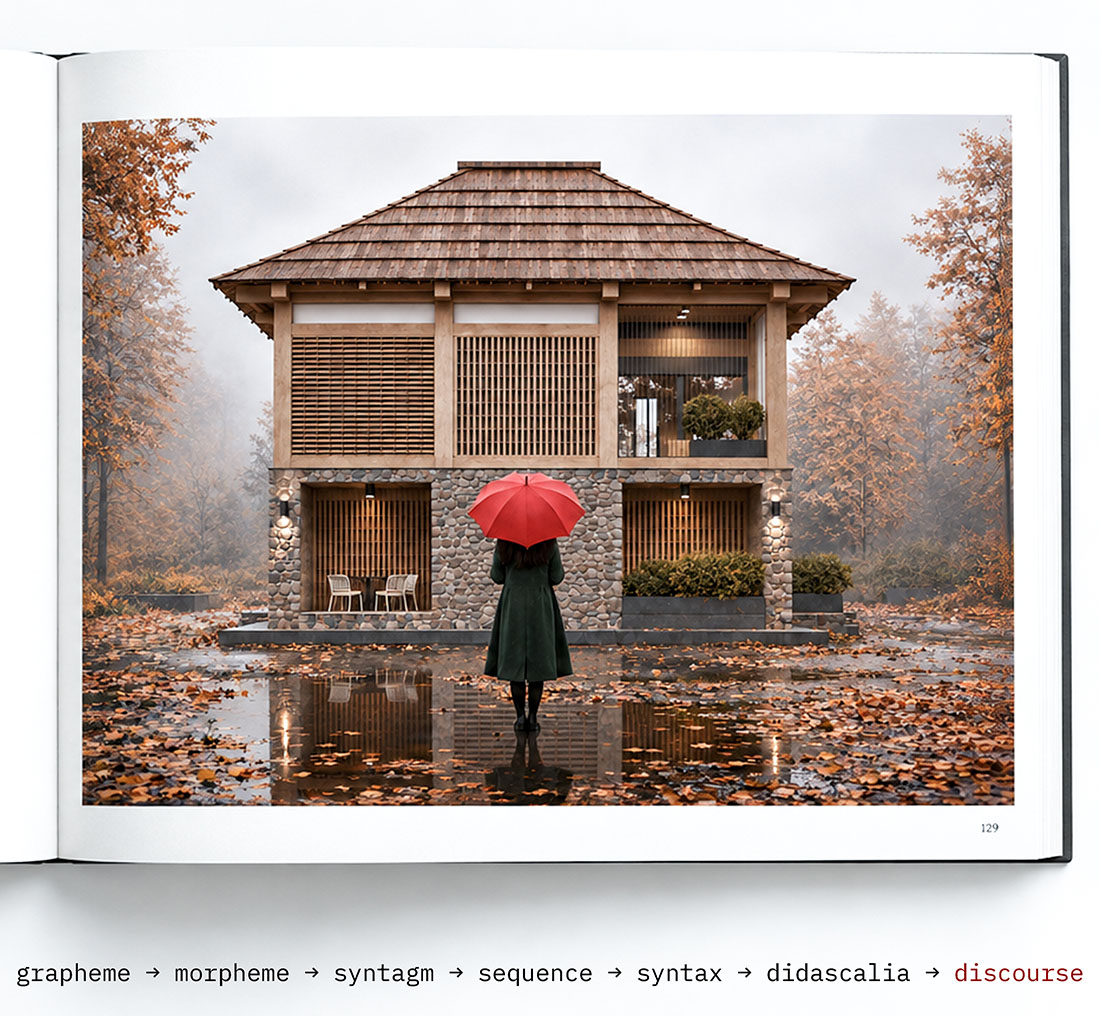
Discourse is the theme — the ultimate meaning towards which architectural syntaxes are directed.
One architectural syntax may speak of boundaries.
Another of community.
A third of individuation, the sacred, memory, nature, power, or transience.
Discourse is what the totality of the design speaks about.
If syntax is the way in which an architectural thought is constructed, discourse is the broader conceptual framework to which that thought belongs.
The grapheme is material.
The morpheme is meaning.
The syntagm is relationship.
The sequence is order.
Syntax is the sentence.
Didascalia is the manner in which that sentence is read.
Discourse is the reason that sentence was spoken in the first place.