
THE EIDETIC DICTIONARY
Srpska verzija / Serbian Version
A NORMATIVE GRAMMAR OF ARCHITECTURAL EPISTEMOLOGY
A contextual framework for understanding architecture as psychic reality
WHO IS THIS FOR?
This treatise is intended for architects, theorists, and students who have transcended the understanding of architecture as a utilitarian discipline of shelter-building. It is intended for those who understand space as an ontological field – a medium through which human consciousness is structured. If you are seeking a methodology that merges engineering precision with Jungian psychology and Platonic metaphysics, the Eidetic Dictionary is your operational tool.
IMPORTANT NOTE: ON THE SCOPE OF THE SYSTEM
Before we proceed, we must establish a clear epistemological boundary. The Eidetic Dictionary does not pretend to be a final, closed “theory of everything.” It represents an initial normative framework – a necessary starting point for one who is just stepping onto the path of mature design.
This system serves as a foundation for the architect who wishes to expand their practice beyond the boundaries of mere materiality and accept architecture as psychic reality. This, therefore, is not the end of your research nor a dogmatic rulebook; this is a contextual beginning and the alphabet with which one learns to articulate the deeper layers of space.
INTRODUCTION: THE CRISIS OF MEANING AND THE RETURN TO THE SYMBOL
Contemporary architecture finds itself in a state of semantic entropy. Having lost its connection with the transcendent and the archetypal, objects have become “mute,” reduced to economic viability and aesthetic exhibitionism. However, in the philosophy of The Architectural Mythologems studio, we start from a fundamental stance: Architecture is a Living Symbol. It is not a passive stage set for human life, but an active psychological agent that shapes our behavior, emotions, and cognition.
To regain the ability to articulate meaning in space, we have developed the Eidetic Dictionary.
This system is not a stylistic manual. It is an epistemological framework – a way of organizing knowledge about the world. The term “eidetic” (from the Greek eidos) refers to the essential form, the idea that precedes materialization. Our task is alchemical: to translate invisible, metaphysical truths (Ideas) into visible, tactile structure (Matter).
This process requires a methodology that unfolds in three phases:
- Ontological Selection (Vocabulary)
- Syntactic Knotting (Grammar)
- Phenomenological Transformation (Experience)
I. VOCABULARY: BINARY OPPOSITIONS AND KNOTTING DUALITY
The universe operates through the dynamics of opposites. Energy arises only when there is a potential difference. In architecture, space gains definition exclusively through Binary Oppositions. Our system recognizes no “gray zones” of compromise, but strives for what we call in our projects Knotting Duality (Knotting Duality) – the active, tense embrace of two primary principles.
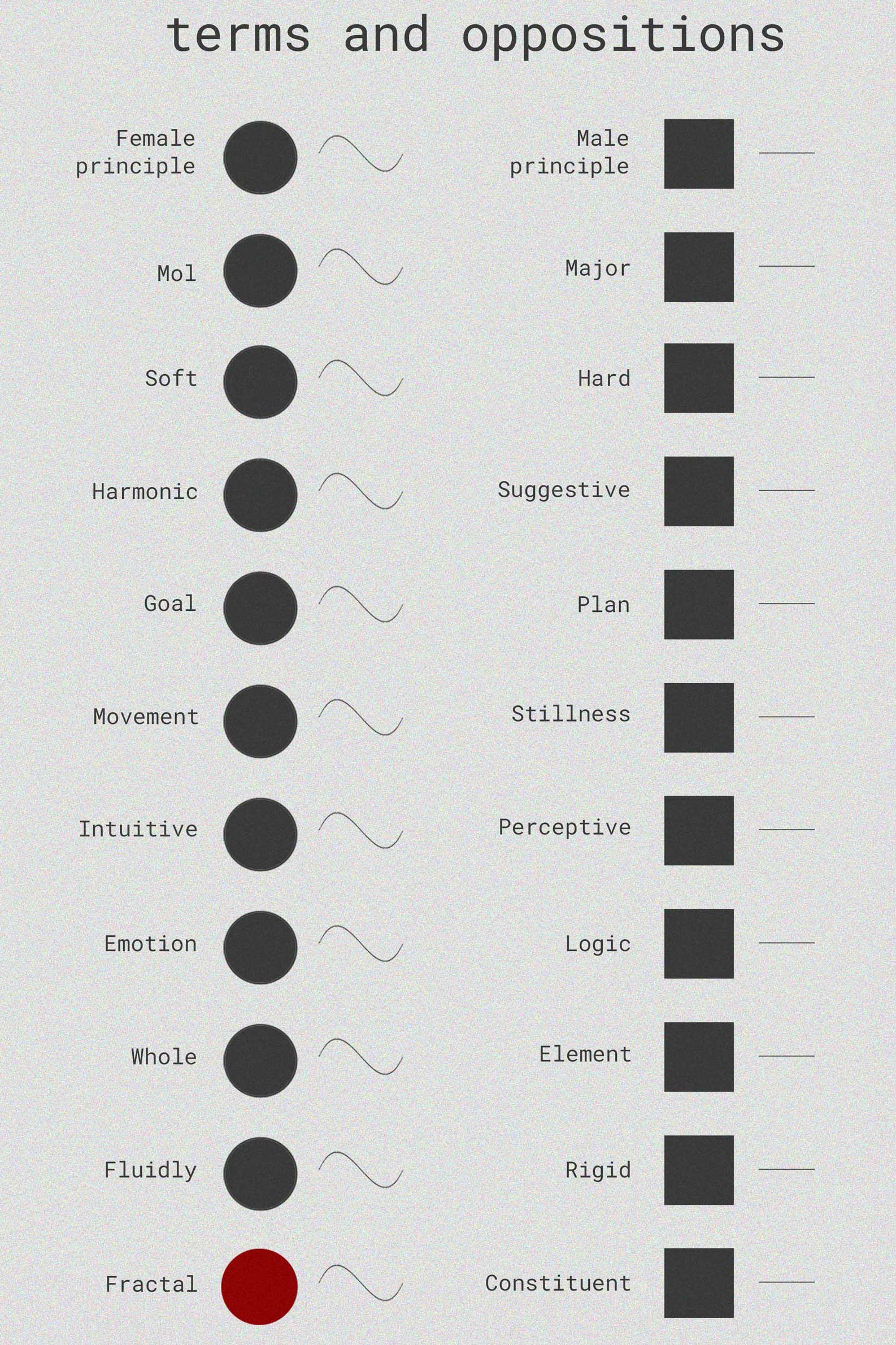
Our operational dictionary rests on two archetypal pillars:
A. THE POLE OF THE SQUARE (LOGOS AND STRUCTURE)
The Square is the geometric manifestation of the Rational. It does not exist in untouched nature; it is the exclusive product of the human mind.
- Cosmological Aspect: The Square is Earth. It is stable, heavy, measurable. It is the Archetype of the Ark – a safe, artificial creation floating on the waters of chaos.
- Psychological Aspect (Animus): The Square represents the Law, the Father, the Social Contract. It provides security through limitation.
- Architectural Application: The orthogonal grid, the wall, the column, the plan. It is the force that parcels out infinite space and makes it comprehensible. Without the square, civilization is impossible; the world would be an impassable jungle.
B. THE POLE OF THE CIRCLE (EROS AND FLOW)
The Circle is the geometric manifestation of the Intuitive and the Natural. It is a line with no beginning and no end, symbolizing eternity and cyclicality.
- Cosmological Aspect: The Circle is Heaven and Water. It is fluid, changeable, elusive. It is the Archetype of the Flood – the force that dissolves boundaries and returns everything to primordial unity.
- Psychological Aspect (Anima): The Circle represents Emotion, the Mother, the Unconscious. It provides care through encompassment.
- Architectural Application: The rotunda, the dome, the vault, the meander. It is the force that allows space to move and breathe. Without the circle, civilization is a prison; the world would be a sterile grate.
Methodological Imperative: The architect does not choose one of these two principles. He is a mediator. His task is to use the rigidity of the Square (Structure) to channel the energy of the Circle (Flow).
II. SYNTAX: THE GRAMMAR OF SPATIAL RELATIONS
The mere presence of forms does not create meaning; meaning arises from their mutual relationship. Just as subject and predicate form a sentence in language, in the Eidetic Dictionary, geometric relationships form a narrative.
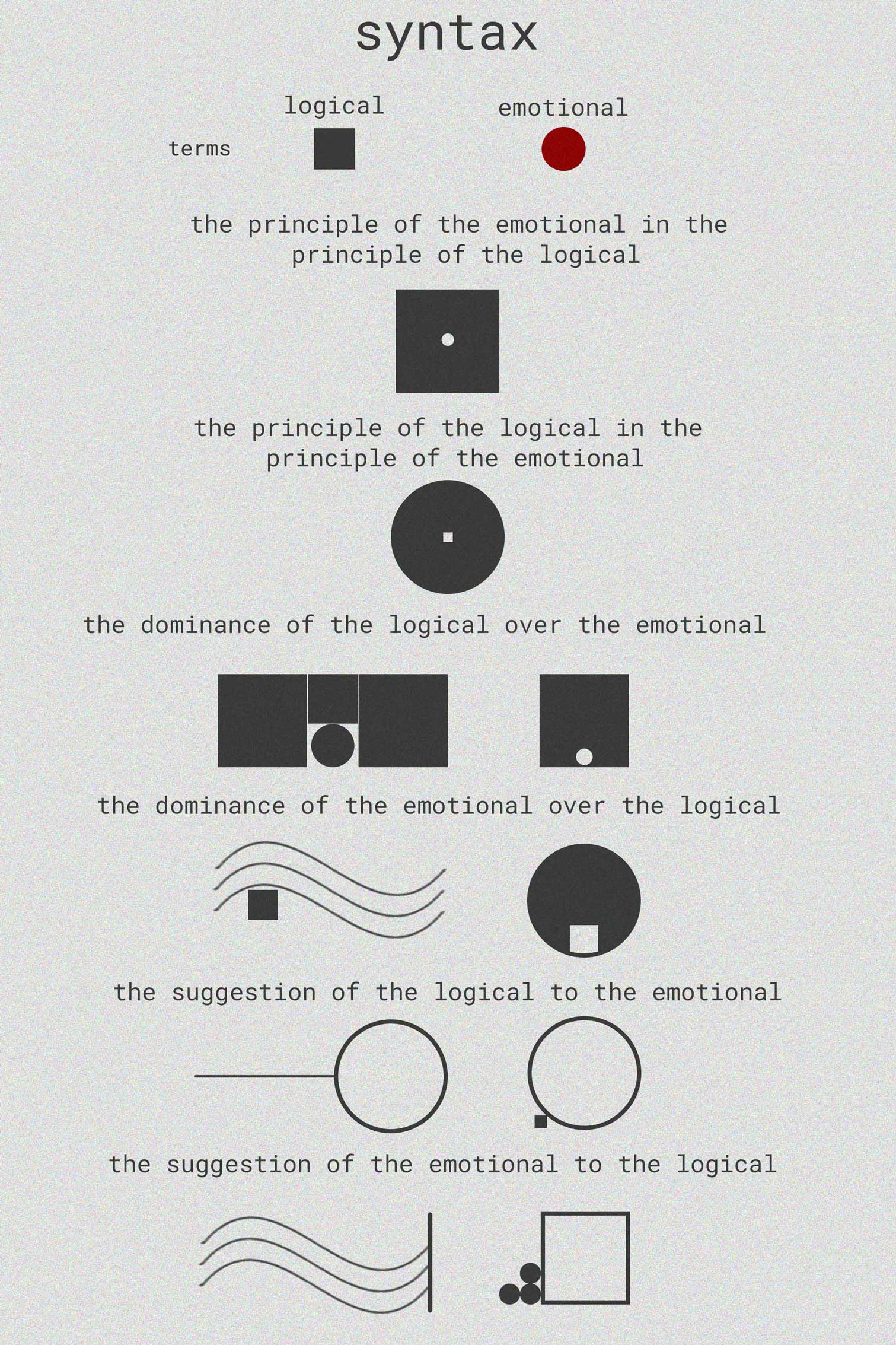
We define three fundamental syntactic models:
1. INSCRIPTION (HIERARCHY AND ESSENCE)
This is a relationship of containment. One form resides within another, defining the ontological core of the space.
- The Ghost in the Machine (Circle in a Square): When an irrational, sacral, or natural core (Circle) is placed inside a rational, protective shell (Square). This is the typology of the Temple or the Atrium. Here, logic serves emotion; walls exist to guard the void in the center.
- Consciousness in Chaos (Square in a Circle): When a rational element is placed within an organic environment. This is the archetype of the Island or the City. Here, human order is established within natural entropy.
2. INTERACTION AND DEFORMATION (DYNAMICS OF FORCE)
Space is not static; it is a field of forces. When two principles collide, a deformation occurs that tells a story of influence.
- Logos Disciplines Eros: Straight lines cut or channel organic forms (e.g., river flow regulation or an urban grid cutting through a hill). This suggests the domination of will over nature.
- Eros Softens Logos: Organic forces exert pressure on the orthogonal grid, bending it (e.g., the movement of people deforming planned paths). This suggests the adaptation of the system to life.
- Minimal Grammar: Often, a minimal shift is sufficient—a slight curvature of a wall or a tangential touch—to change the entire character of a space from rigid to hospitable.
3. SYNTHESIS (HEGELIAN DIALECTICS)
The ultimate goal of every architectural intervention is The Whole. This is not a compromise, but a new quality.
- Thesis: Square (Structure).
- Antithesis: Circle (Event).
- Synthesis: An architectural organism that is both stable and fluid. This is the moment when the user no longer notices the boundary between inside and outside, between themselves and the space.
III. PHENOMENOLOGY: ADVANCED ARTICULATION TECHNIQUES
Once we master the basic grammar, we move on to “stylistics” – advanced techniques with which we shape perception and deepen the experience of the user. These are the tools used to build mythologems.
1. PHANTASMAGORIC SYNTAX (SPACE OF TRANSITION)
In our work on projects such as bridges or museums, we use the concept of Phantasmagoric Syntax. This is a moment in space where the prevailing rules of reality (gravity, orthogonality) are suspended.
- Mechanism: The gradual dissolution of the solid edges of the Square into the oneiric, fluid forms of the Circle.
- Goal: A cognitive shift. The goal is for the user to “wake up” from the automatism of everyday life. These are spaces of liminality – thresholds between worlds (the conscious and the unconscious), where architecture functions as an inductor of an altered state of consciousness.
2. THE IDEOGRAM OF THE FOREST (RHYTHM AND DEMATERIALIZATION)
One of the most powerful tools of the Eidetic Dictionary is Rhythm. Through strict, mathematical repetition of vertical elements (straight lines), we achieve a paradoxical effect: matter becomes transparent.
- Phenomenon: Just like in a dense forest, the individual tree (element) ceases to be important. The eye stops focusing on obstacles and begins to perceive the atmosphere.
- Psychological Effect: Loss of ego. Rhythm nullifies hierarchy and introduces the observer into a meditative state of merging with the whole. This is architecture that is not looked at, but felt as a frequency.
3. THE SPIRAL AND INDIVIDUATION (THE TEMPORAL DIMENSION)
If we let the table of oppositions flow through time, we get the Spiral. In theory, the Spiral is the geometric equivalent of Jung’s process of Individuation.
- Concept: The Spiral reconciles the linearity of the Square (progress) and the cyclicality of the Circle (repetition). It is an evolutionary movement toward the Center.
- Application: The use of spiral ramps or concentric organization of the floor plan is not an aesthetic whim. It is a tool for guiding the user through a process of transformation. Movement toward the center of the building becomes a physical metaphor for movement toward the center of the Self.
IV. METAPHYSICS OF THE VOID: THE CENTER THAT TURNS THE WHEEL
Western architectural tradition suffers from horror vacui (fear of empty space), obsessively filling space with objects. The Eidetic Dictionary, relying on Eastern philosophy and our essays on “Emptiness as the Center,” teaches the opposite: The Void is the most important form.
Take the analogy of a wheel: it is made of spokes and a rim, but what makes it useful is the empty hole in the middle where the axle goes.
In architecture:
- Walls (Square) and vaults (Circle) are there only to define the Void.
- That void is not “nothing”; it is Potential.
- The architect does not design walls; he designs the silence between them. It is precisely in that silence, in that interspace between Thesis and Antithesis, that Man resides.
CONCLUSION: THE ARCHITECT AS MYTHMAKER
What, ultimately, is the goal of applying the Eidetic Dictionary?
The goal is not the creation of “beautiful” architecture, for beauty is a subjective category. The goal is the creation of True architecture – space that is in harmony with the ontological principles of reality and the psychological structure of man.
Through the Eidetic Dictionary, we transform practice:
- From engineers, we become Encoders of Meaning.
- From builders, we become Guardians of Archetypes.
- From decorators, we become Creators of Mythologems.
We live in an age of fragmentation, where Reason and Emotion, Man and Nature are violently separated. Architecture has an ethical duty to reassemble these fragments. Every line you draw on paper is a decision: are you building a prison or a sanctuary? Are you making noise or music?
The Eidetic Dictionary is your instrument. Learn to play it.
APPENDIX: LITERATURE AND RESOURCES FOR FURTHER STUDY
To fully understand the concepts of the Eidetic Dictionary, it is necessary to consult the source material upon which our methodology rests. The following works represent the theoretical foundation for anyone wishing to explore the intersection of architecture, psychology, and metaphysics.
“The Red Book” – C.G. Jung
A book written by the Swiss psychiatrist and psychoanalyst between 1914 and 1930. It is a record of Jung’s psychological and spiritual development and contains his ideas on the nature of the psyche. It was not published until 2009, many years after Jung’s death. It is considered a central work in Jungian psychology and is often studied by scholars and practitioners of Jungian analysis, particularly in the context of understanding archetypes and individuation.
“Modern Art 1770-1970-2000” – Giulio Carlo Argan & Achille Bonito Oliva
A renowned book written by two leading Italian art historians. It covers modern art’s chronological and artistic development and comprises two autonomous studies with different methodologies and ideological approaches. It is crucial for understanding the evolution of form and the aesthetic upheavals that shaped today’s perception of space.
“History of Beauty” – Umberto Eco
A reflection on the cultural history of the concept of beauty, its evolution, and its significance, as well as its historical and cultural meanings. The author analyzes the different forms of beauty that have been valued and developed through different historical periods, cultures, and artistic movements.
“A Theory of Semiotics” – Umberto Eco
A seminal work written by the prominent semiotician, philosopher, and literary critic. It is considered a classic in the field of semiotics, providing a comprehensive and systematic approach to the study of signs and symbols and their role in communication. The book is an vital resource for architects interested in understanding how space “speaks” and conveys meaning.
“Syntactic Structures” – Noam Chomsky
A book by the American linguist, philosopher, and social critic. The book lays the foundation for the study of transformational-generative grammar, which Chomsky developed in the 1950s and 1960s. For our system, this is key to understanding how a limited set of rules can generate an infinite number of variations in language, and by analogy, in architecture.
“Gradoslovar” – Bogdan Bogdanović
A book written by the Serbian architect, town planner, and theoretician. The book is written in a Dictionary style, with each entry providing a definition, explanation, and vocabulary illustrations of architectural symbols and motifs. Overall, it is a very informative and insightful book for those who are interested in the symbolic meaning of architecture and serves as a direct methodological predecessor to our Eidetic Dictionary.
“The Republic” – Plato
A work by the Greek philosopher Plato, and one of his most famous and widely read books. It is a political dialogue in which Plato presents a vision of an ideal society ruled by philosopher-kings. Divided into 10 books, Plato considers the nature of justice and the ideal structure of the state, establishing the philosophical foundations of order and hierarchy.
“Timaeus” – Plato
Another famous book written by Plato; it is a dialogue between Socrates, Timaeus of Locri, and Critias. In this book, Timaeus presents a cosmogony or account of the origins of the universe. The book covers the nature of time and space, the nature of matter (including the geometric basis of the elements), the nature of the soul, and the relationship between the soul and the body.
Note: Overall, there are numerous resources available for those interested in the use of geometry in architecture. Whether you are an architect, designer, or simply someone who is interested in the intersection of architecture, psychology, and literature, these resources can provide valuable insights into the ways in which geometry can be used to create symbolic and complex allegories in space.